Press Fittings Cut Labor & Downtime in Phoenix Services’ Emergency Mall HVAC Job
Key Highlights
- Phoenix Services successfully used press fittings for a high-elevation HVAC installation at West County Mall, avoiding unsafe brazing methods.
- Press fittings are user-friendly, allowing technicians of varying skill levels to perform installations confidently and consistently.
- Adopting press fittings has helped Phoenix Services lower project costs, bid more competitively, and grow their business.
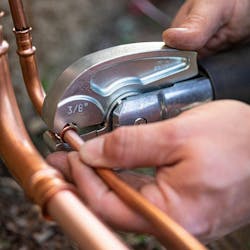
When David Elliott, project manager at Phoenix Services, and his team received the call to work on a commercial installation at a shopping mall, they quickly realized that this job would require some creative maneuvering.
Phoenix Services, a family-owned HVAC contracting company based in Trusdale, Missouri, is comprised of a small team of technicians who aren’t afraid to think outside of the box when it comes to installations. Elliott shared a recent example when the company needed to tackle an emergency job at the West County Mall that required his team to shift gears quickly.
“When we got the details of the job, we immediately realized that this installation could not be completed with anything other than press fittings,” Elliott recalled.
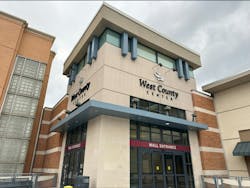
Indeed, with the Carrier Air Handler unit needing to be installed 12 feet in the air above a manager’s office, the Phoenix Services team knew that it would not be possible to use brazing or soldering on this project safely.
“There was no platform we could utilize, so trying to juggle torches 12 feet in the air was out of the question. Additionally, if we were somehow able to get a torch up that high, we would only be allowed to braze at 5 a.m. to avoid having exposed flames with mall employees and customers on-site,” Elliott shared.
With brazing and soldering out of the question, Elliott and his fellow Phoenix Services techs knew that press fittings would be the only safe option. When it came to choosing which press fittings to use for the installation, the choice was clear — Rapid Locking System (RLS) press fittings.
“With this being an emergency job, we didn’t have time to waste on using anything other than press fittings. We had already used RLS previously, and they were always reliable in past applications. We were able to get the press fittings fast and installed them the same day,” Elliott stated. “If we had used soldering for this job, it would have taken 2-3 days for the unit to be up and running before we could even begin.”
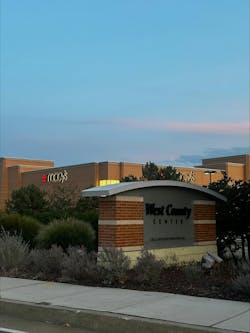
Utilizing press fittings for emergency jobs clearly illustrates the trust that industry technicians have in using press as an installation tool. In fact, shortly after completing the West County Mall job, Elliott found himself on another project that required press fittings.
“One of the next jobs my team and I worked on involved 24 mini split systems that were having some leak issues due to brazed fittings that we wanted addressed quickly. I knew that the best option for this project would be to use RLS fittings because it would fix the leaks and save us time and money,” Eliott noted.
When addressing leak issues, the process of determining where the leaks originate, fixing each leak, and then repeating the entire procedure for subsequent leaks can take upwards of two hours. The repetitive process of fixing leaks not only increases the overall labor costs of a project but can prolong the overall timeline of what should be a simple repair job.
“With cases that focus on leaks, you can get stuck wasting a lot of time on a relatively simple task. We use press fittings for all projects related to fixing leaks because we know they’ll be a leak-free fix the first time around and will be a lot more efficient,” Elliott stated.
Also, Elliott and his team are able to leverage the user-friendly nature of press fittings to engage all technicians on the Phoenix Services team.
“If we wanted to use soldering to fix these leaks, I would have to make sure that whoever I put on the task had a proven track record of being good with the flame and torch approach. With RLS, I know that if I give any of my installers their press tool, they are going to be able to handle the project and it will be done well,” Elliott shared.
Elliott also noted that they leverage press fittings any time a hot work permit would be needed to complete an installation. Additionally, a large portion of the projects that Phoenix Services bid on are now being completed with press fittings, as it is quick and cost-effective and a preferred method of the technicians.
Utilizing RLS to reduce labor hours has enabled David Elliott and Phoenix Services to bid on jobs at a lower overall cost, thereby increasing their competitive edge in the market and contributing to the growth of their company.
About the Author
Micah Heintz
Micah Heintz serves as regional sales manager for RLS, supporting contractors and distributors across the Central U.S. Since joining the team in 2023, he’s been a hands-on resource for everything from jobsite training and product support to system troubleshooting and sales enablement.