How to Boost ROI with Dual Fuel Rooftop Units
Key Highlights
- Dual fuel RTUs optimize energy use by switching between heat pumps and gas heating based on external temperatures, reducing fuel consumption and operating costs.
- Installation of dual fuel RTUs requires fewer electrical upgrades, making transitions smoother and more affordable for building owners.
- Connected systems enable remote monitoring and diagnostics, allowing proactive maintenance and minimizing downtime.
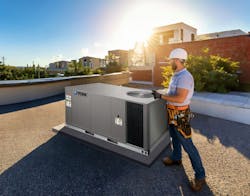
Rooftop units (RTUs) have long been a cost-effective way of keeping commercial spaces comfortable. Rather than necessitating separate machines to handle the heating and cooling process, they allow building owners to reap the benefits of a convenient, all-in-one packaged solution, combining heating, refrigeration and filtration properties in one unit – simplifying installation, saving space, and offering greater cost-efficiency per ton.
From evolving legislation to corporate net-zero targets, the pressure is mounting for building owners to explore electrified HVAC applications — though hesitations prevail around high upfront and operating costs, complicated installations, and more.
If this sounds like your customers, let’s discuss how advancements in modern heat pump technology stand to improve — not reduce — ROI with RTUs.
The Evolution of the RTU
Historically, we’ve had three types of RTUs to work with: one solely for cooling, one that combined traditional air conditioning technology with gas heating, and the heat pump, which uses the same refrigeration process to provide heating and cooling by transferring heat either from outside-in or inside-out.
Heat pump RTUs changed the game in terms of driving efficiency for buildings in milder climates — but these units can struggle to provide the same level of performance in regions where ambient temperatures are near zero degrees or below.
In the past, the workaround was to utilize electric heat to augment what the heat pump was struggling to deliver. The problem is that even if performance is made up for with increased electricity usage, the primary benefit to a heat pump — its enhanced energy-efficiency — is therefore sacrificed.
Amid initiatives like the Department of Energy (DOE)’s Commercial Building HVAC Accelerator, HVAC manufacturers are innovating heat pump technology better equipped to deliver efficient heating in sub-zero temperatures — a feat that was accomplished on the residential side with the DOE’s Residential Cold Climate Heat Pump Challenge.
But in the meantime, dual-fuel technology has emerged as the latest breakthrough set to transform RTUs in 2026.
Dual fuel systems utilize heat pump technology whenever conditions are mild enough to warrant efficiency, and, in very cold conditions, supplement that technology with gas heat. By utilizing whichever heat source will prove most cost-effective and energy efficient given external circumstances, this unit successfully reduces overall fuel use while also minimizing reliance on inefficient electric heating.
Streamlining Installation, Operation & Maintenance
The switch from a gas heat RTU to a heat pump has traditionally been a dramatic one, facing building owners with hefty costs to upgrade service wiring and other components to allow for greater electrical capacity in the building.
This is one area where a dual fuel system can significantly help with bridging the transition, as they require fewer electrical upgrades — offering a more seamless installation for contractors, and a more affordable process for building owners.
The accessible packaged makeup of RTUs makes them incredibly convenient to service, and dual fuel systems are no different — comprised of two technological solutions contractors have long-held experience with.
The misconception that the market isn’t prepared to maintain heat pumps is an outdated one. Technicians have a healthy arsenal of best practices established in this arena by now, and are innovating new solutions for keeping these modern systems up to speed all the time. For instance, the traditional defrost cycle, which heat pumps initiate, melts ice on the outdoor coil, causing water to accumulate on the roof and occasionally freeze. While this may be a unique challenge that traditional RTUs do not present, that’s no reason to shy away from heat pumps — contractors have simply adopted new preventative measures as part of their routines, such as draining water off the roof before it freezes or applying electric heat to the place where water accumulates so it can’t freeze.
The hardware used in RTUs, dual fuel, and beyond is also paving the way for enhanced serviceability. For example, the traditional supply fan setup in RTUs involved a motor and belt, the latter of which was prone to breaking and emitting dust and other particles into the unit as it wore and tore. Newer machines combine the motor and fan into one connected part, known as direct drive fans, which adjust speed more easily and promise greater reliability.
Connected systems enhance this serviceability even further. Remote monitoring capabilities allow contractors to pick up on deviations in performance from miles away, enabling near continuous performance trending so you can head out and address reduced capacity or abnormal operation before customers even realize it’s an issue. Connected systems also streamline the troubleshooting process, allowing technicians to identify the root of a performance issue without necessarily having to remove a single panel.
Opting for a system with digital controls is vital for enabling the connectivity-related updates outlined above — and it’s also important for promising the precise comfort your customers deserve. Economizers are another common but crucial component to a well-functioning RTU, as they help save money and energy by bringing in fresh air to support cooling instead of activating the refrigeration process when it’s unnecessary. And finally, hot gas reheat — a function where outside air is brought in, cooled below temperature needs and reheated with hot gas to a more comfortable level — is another must-have feature for humidity control in commercial spaces.
Selling the Value of Dual Fuel RTUs
In summary, there are a few key ways dual fuel RTUs stand to improve ROI that you should emphasize to your customers, including:
- Lower operating costs AND a smaller carbon footprint;
- Better comfort and reliable heat even in extreme cold snaps;
- Compliance with evolving incentives and corporate net-zero carbon emission targets;
- Enhanced energy efficiency with fewer costly electrical upgrades; and
- Streamlined installation and upkeep, with connectivity features supporting enhanced preventative maintenance and reduced breakdowns.
The next time your customers express hesitation regarding the mounting pressure to pursue electrified HVAC technologies, remind them that a simpler path to greater ROI and efficient, reliable comfort exists in dual fuel RTU applications.
About the Author
Philip Smyth
Philip Smyth is an executive director of product management at Bosch Home Comfort Group, where he manages unitary packaged rooftops, splits systems, and other light commercial systems.