Rooftop Heat Pump Demand Surges as Electrification Reshapes Commercial HVAC
Key Highlights
- Rooftop heat pumps are gaining popularity due to improved cold-weather performance, variable-speed technology, and integrated smart controls.
- Contractors must understand new sizing logic, electrical requirements, and system integration to ensure proper installation and operation.
- Onboard diagnostics and remote monitoring are becoming standard, enabling proactive maintenance and quicker troubleshooting.
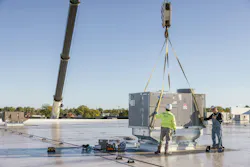
Rooftop heat pumps are gaining momentum across commercial and light commercial HVAC applications. Advances in cold-climate performance, variable-speed technology, and integrated controls have made today’s rooftop units far more efficient and versatile than earlier generations, allowing them to reliably replace traditional gas-fired systems in a wider range of climates.
“Demand is increasing, driven by a combination of regulatory updates, efficiency standards, and the industry’s broader push toward more advanced, high-performing systems,” says Rosa Leal, director, commercial product strategy and experience, U.S. Air, Rheem North America. “In addition, building codes are incorporating and mandating the type of equipment used, like Title 24 in California.”
Carl Breczinski, light packaged rooftop portfolio leader for Trane Commercial, notes that demand for both traditional heat pumps and hybrid dual-fuel models continues to grow. “Many building owners are prioritizing sustainability and electrification, while regulatory changes are encouraging lower onsite emissions and reduced reliance on fossil fuels. Financial incentives and rebates are also helping offset upfront costs. At the same time, heat pump technologies have advanced significantly, improving cold‑weather performance and expanding the range of viable applications.”
Carrier has also seen a clear increase in demand for rooftop heat pumps, but there is also still hesitation in the market, based on performance on those coldest days, explains Christina Bullock, director of product management at Carrier.
“Other adoption barriers include electrical infrastructure limitations, higher upfront costs compared to a 100% gas rooftop unit, and a lack of contractor familiarity and training,” she says.
What Contractors Need to Know
One of the most important things HVAC contractors should be aware of is that heat pumps require different sizing logic, Bullock explains.
“For example, heat capacity matters more than the traditional cooling capacity and relies heavily on controls and sensors,” she says. “So weather conditions can also have a large impact on performance — things like wind, something that may not have been considered before, have an impact.”
Bullock says Carrier’s new rooftop and hybrid heat pump units are designed as a natural evolution of its legacy platforms, allowing contractors to work with familiar equipment.
According to Leal, heat pumps have three primary differences from traditional RTUs: heating source, electrical requirements, and system integrations.
“The heating source shifts from gas to an electric heat pump and how the unit works,” she explains. “Traditional RTUs use natural gas or electric resistance for heat, whereas a heat pump uses the refrigeration cycle to provide both heating and cooling. The electrical requirements will be higher, which is the biggest installation difference, as heat pumps require a greater electrical capacity. And heat pumps often feature more advanced, smart controls along with defrost cycles.”
Leal emphasizes that modern rooftop heat pumps are designed with footprints similar to traditional RTUs, making replacements more seamless when contractors are properly trained in system application and sizing. While installations involve some new considerations, Leal says they become straightforward with training, and improved equipment design is making systems easier to install, service, and maintain overall.
Compared to traditional RTUs, rooftop heat pumps require more attention to the total cost of ownership, especially heating performance at various outdoor temperatures, Breczinski notes.
“Installations are generally not more complicated—they’re simply different,” he says. “The mechanical steps will feel familiar to anyone experienced with traditional RTUs, but rooftop heat pumps introduce several elements that require closer attention. Contractors need to account for full‑electric heating operation, understand defrost behavior, correctly configure auxiliary heat, and ensure the controls are set up to deliver the intended comfort, efficiency, and performance. When these factors are addressed upfront, installations are straightforward and predictable.”
In terms of maintenance for these systems, while the core maintenance tasks remain similar, there is a greater emphasis on consistency and adherence to recommended schedules, Leal explains.
“Skipping routine tasks, like filter replacements, or coil cleaning can significantly impact system performance over time,” she says. “Maintenance is best approached as scheduled and preventative, with intervals tailored to the specific environment and application. Different operating conditions may require different frequencies, making a one-size-fits-all approach less effective.”
The key difference, Breczinkski adds, is that because rooftop heat pumps rely on the refrigeration cycle year-round, coil cleanliness, airflow, and refrigerant performance have a greater impact on heating output. “Technicians also need to verify reversing valve operation, temperature sensors, and defrost sequences. Because the compressor runs in both heating and cooling seasons, regular performance checks become more important than with cooling‑only RTUs.”
Diagnostics, Remote Monitoring Becoming Standard
Onboard diagnostics and remote monitoring are increasingly important in helping contractors and facility managers take a more proactive approach to system performance and maintenance, Leal explains. “By providing greater visibility into how equipment is operating, these technologies can help identify potential issues earlier. This supports a broader industry shift toward preventative maintenance, where routine service and system insights help keep equipment running efficiently over time. It also allows contractors to be better prepared when service is needed, improving overall response times and reducing unnecessary troubleshooting in the field.”
Bullock adds that this type of technology helps fill the knowledge gap within the HVACR industry as the labor shortage persists.
“There's a lot more parts changers than there are true troubleshooters,” she says. “We’re looking at how to expand our connectivity across our platform so we can have those insights at the contractor's fingertips. Because what really matters is ensuring that, whether they're in their office or their home, they can troubleshoot and identify what they need to do before they get to the site. That way, they're spending less time and they can move to the next job quicker.”
Electrification Is Here — Get Ahead of It
Bullock’s advice for contractors in preparing for the future is simple: keep learning. “Solutions are evolving every day, and contractors must stay informed on that evolution. We’re here to help educate and drive that knowledge.”
Leal notes that contractors must have a strong foundation in installation best practices, combined with ongoing training in new technologies. “The skilled labor shortage remains one of the HVAC industry’s most urgent challenges in 2026 and beyond. Contractors that are finding ways to complete projects more efficiently while maintaining high-quality standards, often with leaner teams, are increasing profitability and gaining a competitive edge in winning new business.”
Breczinski agrees that contractors should continue learning and expanding their knowledge of today’s heat pump offerings, so that they can confidently discuss performance and application options with customers.
“Contractors who stand out in the coming years will understand how heat pumps interact with different building types—recognizing where they’re a strong fit, how heating profiles vary, and when hybrid or dual‑fuel approaches make the most sense,” he says. “As equipment and controls platforms continue to advance, strong capabilities in system setup and integration will be increasingly important. Just as critical is staying current on local regulations, incentives, and utility structures so contractors can guide customers through the evolving landscape of electrification and help them choose the right solution for their building.”
Rooftop heat pumps are quickly becoming one of the most practical and scalable paths toward commercial building electrification, Breczinski adds. “The technology is evolving fast, performance is improving across climate zones, and more customers are factoring sustainability and long‑term operating costs into their decisions. Contractors who invest time today in understanding the systems, controls, and application considerations will be well‑positioned as trusted advisors. As more buildings transition toward electrified or hybrid heating strategies, skilled HVAC professionals will play a central role in delivering reliable, efficient, and future‑ready solutions.”
About the Author
 Nicole Krawcke
Nicole Krawcke
Nicole Krawcke is the Editor-in-Chief of Contracting Business magazine. With over 10 years of B2B media experience across HVAC, plumbing, and mechanical markets, she has expertise in content creation, digital strategies, and project management. Nicole has more than 15 years of writing and editing experience and holds a bachelor’s degree in Journalism from Michigan State University.