Balancing Energy Efficiency and Water Use in Data Centers
Key Highlights
- Metrics like PUE and WUE are essential for evaluating data center efficiency and sustainability, guiding technology selection.
- Site-specific factors such as climate, water availability, and space influence the optimal cooling strategy for each data center.
- All heat rejection comes with its own benefits and drawbacks, from energy and water use to footprint and cost.
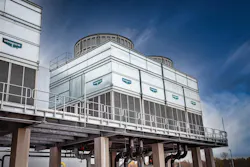
The colossal computing power that data centers are capable of have one very specific downside (that is, aside from the energy required to process and store information): they produce heat. Lots of it.
Yet, there are plenty of viable solutions for resolving the byproduct of computing. To accomplish efficient cooling — and to select or specify the right equipment for the job — typical considerations include geography, equipment footprint, the availability of plentiful water (or not), power requirements, the need for low sound solutions, and design/operating temperatures.
And, for data centers, two additional needs rise to the forefront: Power usage effectiveness (PUE) and water usage effectiveness (WUE).
PUE is a metric used to determine a data facility’s energy efficiency, determined by dividing the total amount of power entering a data center by the power used to run the IT equipment within it. PUE is expressed as a ratio, with overall efficiency improving as the quotient decreases toward 1.0.
WUE is the ratio between the annual site water usage in liters divided by the IT equipment energy usage in kilowatt hours (kWh) — a sustainability metric developed in 2011 by The Green Grid to measure the amount of water used by datacenters to cool their IT assets. The goal: a 0 (zero) rating.
As long as ambient temperatures are below the temperatures within a data facility, heat can be removed efficiently, resulting in a very low PUE rating. When outdoor temperatures are higher than within the data center, mechanical cooling technology is usually required.
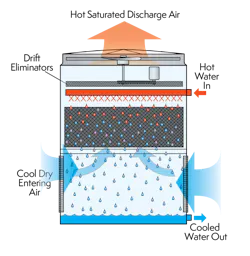
The higher the Delta T between ambient and indoor temps during the summer months, the greater the challenge of reducing thermal energy within the facility, requiring more electrical energy to accomplish it. These circumstances become the “perfect storm” for evaporative cooling — the undisputed leader in its ability to efficiently, inexpensively dissipate heat into the atmosphere.
Evaporative cooling offers the greatest benefit in warm, dry climates. Outdoor air with high temperature and low humidity can easily, efficiently be used to reject substantial heat. The more hours per year with high temperatures and low humidity, the higher the savings with evaporative cooling.
Areas with colder temperatures and/or high humidity offer less potential for evaporative cooling.
The benefits of evaporative cooling include:
- Energy efficient thermal energy transfer;
- Suitability to a broad range of climates and geography;
- Safe, durable, and reliable; and
- Low up-front cost, compact footprint and minimal connected horsepower.
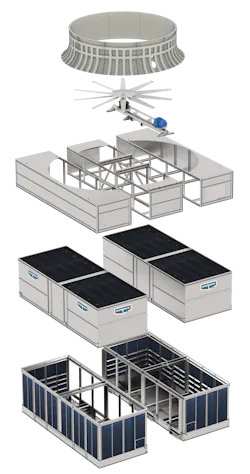
Considerations for Data Centers
Evaporative cooling is a great way to dramatically reduce a data center’s PUE, but it does have its own considerations. Direct evaporative cooling accomplishes the needed heat rejection with the lowest comparative cost and footprint, though greater water usage to accomplish cooling is required.
Also, humidity should be carefully monitored, even though ASHRAE standards recommend anywhere from 20 percent to 80 percent relative humidity, a wide and forgiving range. It’s also important to point out that with evaporative cooling technology, water treatment and filtration systems may be necessary to avoid system or airstream contamination.
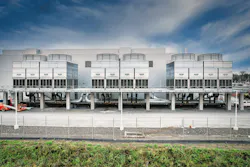
Considering water usage to accomplish cooling, it may be significant for data facility planners to consider the full spectrum of technology — from evaporative equipment, to hybrid, to adiabatic, to dry.
Hybrid cooling combines evaporative and dry cooling to accomplish effective heat rejection while also reducing water and energy consumption. In this category, an evaporative cooler that has an additional dry coil above the spray branches gives the benefits of evaporative footprint and energy use while reducing water use and improving WUE drastically.
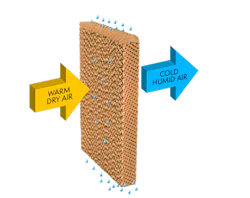
Adiabatic cooling systems function similarly to dry cooling systems, but with the incorporation of pre-cooling pads. Air is drawn through these water-moistened pads that, as a result, effectively reduce the ambient dry bulb of the incoming air — allowing for greater system heat rejection.
Dry cooling equipment removes thermal energy from a facility through sensible heat rejection. The lack of water and attendant water treatment substantially reduce maintenance of the equipment.
Air flow and surface area play an important role in maximizing the effect of dry cooling. To accomplish it, fluid runs through a series of stainless steel tubes and conductive aluminum fins. Large quantities of air are drawn through the coils to remove heat from the system which is transferred into the atmosphere.
Where water conservation is of vital importance, EVAPCO’s eco-Air double stack dry coolers are designed specifically to maximize heat rejection where limited space is a concern. They are 100 percent fully rated, and third-party CTI Certified for dry performance (no use of water to accomplish cooling), and range in nominal heat rejection capacity from 2,750 MBH to 8,440 MBH.
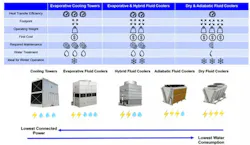
All heat rejection comes with its own benefits and drawbacks, from energy and water use to footprint and cost. Understanding how these options compare is a crucial step in designing the optimal solution for a bespoke data center. Every site and project is unique and must be treated as such. Below is a qualitative view of how the different heat rejection technologies above compare to one another.
As data centers continue to expand their role as the backbone of the digital world, the importance of selecting efficient, sustainable, and site-appropriate cooling solutions has never been greater.
Evaporative cooling remains a cornerstone technology — proven, powerful, and adaptable, delivering exceptional energy efficiency and low PUE in many climates. Yet, today’s operators must balance that efficiency with growing demands for water stewardship and operational flexibility.
By understanding the full spectrum of available technologies — from fully evaporative to hybrid, adiabatic, and dry systems, designers can tailor solutions that achieve optimal performance while meeting site-specific constraints.
In a new world that is sprinting toward dry solutions, evaporative cooling is still a viable and effective option for the modern data center.
About the Author
Andrew Kollasch
Andrew Kollasch is a product application manager, Data Centers – Americas, for Taneytown, Maryland-based EVAPCO.