How Geothermal and Radiant HVAC Helped Create a Net-Positive School
Why It Matters
- The project demonstrates how contractors can combine geothermal heat pumps, radiant systems, and hydronic technology to create high-efficiency HVAC solutions for commercial buildings.
- Radiant systems paired with geothermal heat pumps can provide an opportunity for contractors to apply hydronic expertise in projects focused on energy efficiency, occupant comfort and indoor air quality.
- Strong collaboration among contractors, engineers, manufacturers and local representatives can help teams evaluate system options, properly size equipment and select products that support a project’s overall objectives.
- The project shows that HVAC installations can become part of a building’s broader sustainability and education strategy, creating opportunities for contractors to demonstrate the value of mechanical systems beyond heating and cooling.
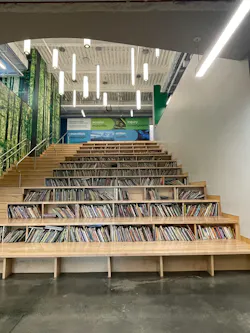
At the Academy for Global Citizenship (AGC), serving the community isn’t just a mantra; it’s a model for everything they do. Spanning six acres on Chicago’s southwest side, on the former site of the Chicago Housing Authority’s LeClaire Courts complex, the AGC campus houses a dual-language charter school, early childhood education center, a community healthcare center, neighborhood market and more. To say that residents and students depend heavily on this community hub would be an understatement.
The Challenge
How could more energy, ideas and creativity be created than what is consumed? That is the broader vision behind AGC’s focus on being the most sustainable school of the Midwest, where everything from the classroom to the cafeteria contributes to a climate-friendly output.
“At AGC, we’re intent on developing 21st century learners who are able to address a lot of the changes that their generation is going to be confronting with increasingly complex challenges around climate change. And so, everything we do at the campus—from the curriculum to the operations of the building—is around this kind of net positive ethos,” said Paul Guilianelli, chief operating officer, AGC.
As part of this commitment, the AGC is aspiring for the Living Building Challenge certification, the most rigorous standard for sustainable building worldwide. The school would be the first building in the Midwest to achieve this cutting-edge certification.
In its quest to develop a net positive water and energy campus, the Academy needed a partner who could think outside the box to help achieve its goals, including on-site power generation and maximizing the efficiency of its building systems. What’s more, the project required exploring an alternative to electric boilers, which can be both inefficient and expensive to operate.

The Solution
Just as everything from the Academy’s curriculum to its building operations is built around a net positive ethos, so was its thinking around system design, product and vendor selection, as echoed by those on the project.
From the very beginning, AGC sought project partners that shared the same commitment to promoting sustainability and reducing environmental impact. They discovered just that in Bornquist, a Xylem Bell & Gossett manufacturing rep, who, alongside local engineering firm dbHMS, was commissioned to design and install the highest possible efficiency HVAC system to reduce energy demand.
“Sustainability was at the forefront of our design from start to finish,” noted Sidd Anand, mechanical engineer with dbHMS.
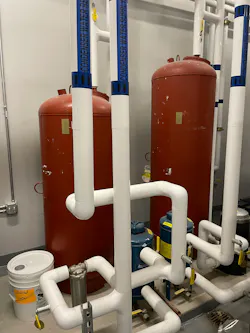
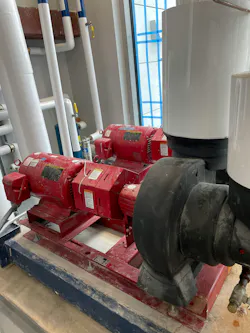
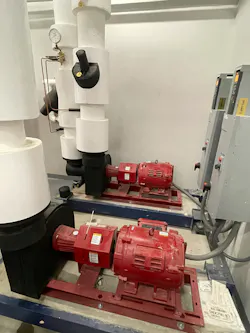
Early on, Bornquist tested different system options to meet the AGC’s sustainability goals. A hydronic radiant system proved to be the most effective solution for achieving energy efficiency, occupant comfort and improved indoor air quality. Because the building doesn’t rely on fossil fuels, dbHMS chose a geothermal ground-source heat pump system. This, in tandem with Bell & Gossett Series e-1510 centrifugal pumps and Series e-90 close-coupled in-line centrifugal pumps, play a critical role in optimizing the Academy’s geothermal system performance, supporting the efficient circulation of hot and cold water through geothermal loops and proving the power of partnership.
“Radiant heat isn’t new, but when you pair it with geothermal systems—using the ground as a heat sink—you get a huge efficiency boost. Radiant floors work really well because they use lower temperature water, which matches perfectly with geothermal systems. That combination allows us to heat and cool buildings much more efficiently than traditional air systems.” — Dan Watkins, sales engineer at Bornquist Inc
President of Bornquist, Dave Everhart, reiterated the effectiveness of the system design employed at AGC: “Water carries a lot of energy very efficiently and it can do that over a wide space. If you tried to push air through a duct, it would give up energy over time, so that by the time it got where it was emitted into the space, it would no longer be cold or warm; water allows that transfer of energy without loss.”
The Results
Since opening its doors in September 2023, the Academy has successfully met its net positive energy and water goals while significantly reducing waste through recycling, composting and awareness programs. In addition to delivering a solution that met AGC’s sustainability mission while lowering long-term operating costs, Xylem’s impact continues to be felt across the campus.
As part of its corporate sustainability program, Watermark, Xylem secured a $10,000 water education and sustainability grant to help AGC continue campus developments and improvements. That included making the school building itself a teaching tool with exposed MEP systems and windows into the mechanical rooms to spark curiosity about the systems that keep the school’s water flowing.
Additionally, Bell & Gossett and its partners came together for an afternoon of volunteering with students, including education around the value of environmental stewardship and activities for the school’s community garden—a testament to the importance of uniting around a common goal of making a difference in the community.
Today, AGC is a national model for holistic community revitalization, drawing visitors from around the world. Students experience a powerful sense of community investment in their education when seeing the innovative building features and understanding the technology behind them.
"Teaching responsible actions by connecting our behaviors to the influence of our individual and collective choices inspires students to carry sustainabilityn into their homes and lives. By reimagining the role of schools in communities, we can address racial, social, and environmental inequalities." — Sarah Elizabeth Ippel, founder and executive director, AGC.
On the success of this project, Susan O’Grady, senior director of marketing at Xylem, said, “Success on this project is really two-fold. One is relationships with our local Bell & Gossett rep, as well as their relationship with local engineer, dbHMS. Those relationships help size the system, help provide the right products and help the school meet their ultimate goal.”
Bringing together the promotion of sustainability and reduced environmental impact under one umbrella, while fostering the next generation through immersive education, was a win-win for the Chicago community.