A Legacy of Leadership and Integrity: Ray Isaac Joins HVAC Hall of Fame
Key Highlights
- Ray Isaac’s leadership transformed Isaac Heating & Air Conditioning from a small family business into a regional powerhouse while maintaining core family values.
- A carefully planned exit in 2021 allowed the family to partner with private equity while preserving the company’s legacy, culture, and employee opportunities.
- His induction into the Hall of Fame recognizes a career built on relationships, continuous learning, and doing the right thing, rather than accolades alone.
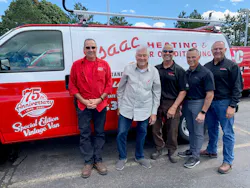
As Ray Isaac is inducted into the 2026 Contracting Business HVAC Hall of Fame, the honor recognizes far more than a single career milestone—it celebrates a multigenerational legacy of leadership, integrity, and community impact.

As a third-generation leader of Isaac Heating & Air Conditioning, Isaac helped transform a small, family-run business into a regional powerhouse while remaining grounded in the core values established by his grandfather. His journey reflects a rare balance of business success and humility, shaped not by the pursuit of accolades but by an unwavering commitment to people, culture, and doing the right thing.
Early Beginnings
Ray Isaac traces the roots of Isaac Heating & Air Conditioning back to 1945, when his grandfather, George T. Isaac, left a union sheet metal job to start his own business despite having a young family to support. Originally named George T. Isaac Automatic Heating and Sheet Metal, the company focused on new home construction during the post–World War II housing boom, building a reputation on steady, disciplined growth rather than rapid expansion. He was also an early innovator in marketing, using branded service vehicles to promote the business, and was known for his creativity and entrepreneurial spirit, Ray Isaac notes.
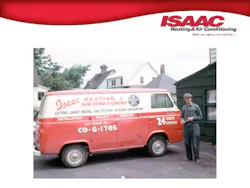
After his grandfather’s passing in 1967, Ray Isaac’s father, Jim Isaac, took over the company alongside his brothers. Over time, ownership consolidated under Jim and one brother, and the business continued to grow. Ray Isaac himself entered the company at a young age, working in the field at 14 years old, and later balancing college with hands-on roles in the business. Eventually, Ray Isaac and his three brothers followed the same path as the previous generation, becoming co-owners and representing the third generation of leadership after purchasing the company in 2017.
Under Ray Isaac’s leadership—beginning when he became general manager and vice president in 1996—the company experienced significant expansion, growing from roughly $6 million in revenue to nearly $70 million, building on the strong foundation established by prior generations.

Responsibility of a Name
Ray Isaac credits his father with instilling a strong sense of responsibility and work ethic from an early age by having him and his brothers start at the bottom and take on the toughest, least desirable jobs.
“He figured I couldn’t quit,” Ray Isaac says with a laugh.
Rather than granting privilege, his father emphasized that carrying the family name was an obligation—one that required accountability, integrity, and consistently upholding the company’s reputation in the community.
“My dad always said our last name was a responsibility — it’s a responsibility to have the same last name as the company. My grandfather, as I said, was inventive. He put his name on the business, and that was one of the most important, impactful things he did to signifiy we were going to run an ethical business. He signed his work every day by having his name on the company. You couldn’t run and hide from it — it’s not like ‘ABC Heating,’ where nobody knows who the owner is. In a small community like Rochester, it was pretty widely known that we owned the business. We always had to be on point, which was kind of tough as four boys growing up.”
Another principle instilled by his father was that compensation is based on performance, not position or lineage. “We weren’t all paid the same. Eventually, I was paid as president and CEO, but my one brother, David, who is probably the smartest in the group, was paid as a service technician. This sets the stage for the rest of the employees in the company,” Ray Isaac notes.
Ray Isaac also reflects on how mentorship — from his father and industry peers from ACCA MIX Groups — helped guide his development, along with a pivotal realization that he could pursue his ambitions within the family business rather than outside it. That shift allowed him to avoid the “legacy trap” of entitlement and instead approach the business with ownership, innovation, and a commitment to growth.
For Isaac Heating & Air Conditioning, long-term success is also tied to community engagement. By consistently investing time, money, and effort into local causes—and embedding charitable giving into the operating budget—the company strengthened its ties to the community it served.
“Giving back is just the right philosophy,” Ray Isaac says. “My dad was a big proponent of that. He installed the HVAC systems in over 100 houses for Habitat for Humanity over 20 years. He was recognized by ACCA with the Skip Snyder Award. That’s just how he and my uncles were — we always supported the community.”

Executing a Successful Exit
One of the most important things for a contracting business owner is planning the exit strategy. The next generation of Isaacs had no interest in the family business, so Ray Isaac and his brothers began looking at private equity partners.
“I think we did a really great job of scaring the hell out of them,” he says of the fourth-generation family members. “My one son is a dentist and a lieutenant in the Navy; my other son is in college and will probably be a pilot or maybe go into law enforcement. One of my nephews, Christopher, is still in the business — he’s an installer with us, but it would have been a difficult transition. The business had grown to a size where it would have been tough to acquire the financial resources.”
The sale, which took place in 2021, was a carefully planned, values-driven process centered on finding the right partner—not just the highest bidder, Ray Isaac stresses. After an extensive search, the company partnered with True Arc Partners, which he says has exceeded expectations by supporting the family, employees, and community while avoiding the negative outcomes often associated with private equity.
Family alignment also played a critical role. The brothers had a long-standing agreement that any major decision — like selling the business — had to be unanimous, ensuring trust and preventing conflict. This approach helped them delay the sale when one brother wasn’t ready, ultimately leading to better timing and alignment.
The key to the successful exit was establishing clear “must-haves” upfront. These included allowing the Isaac brothers to remain involved in the business, preserving the company’s legacy and name, and creating continued opportunities for employees. The private equity partner honored all of these priorities, even extending the brothers’ involvement beyond initial agreements. Over time, Ray Isaac transitioned from CEO to executive vice president of industry relations, while his brothers eventually retired.
“They made up a title that makes me sound really important,” Ray Isaac says. “I define myself as the pure definition of irrelevant, but it is kind of nice. I’m having a blast. When you’re running a business, you get hammered with questions all day and every decision could have drastic consequences. Now, I get asked two questions: ‘Are you available,’ and ‘What do you think?’ I like that.”
Ray Isaac says that even though he’s no longer involved in day-to-day operations, he still feels a strong sense of responsibility to customers. When issues reach him directly, he steps in to ensure they’re addressed, maintaining the same level of accountability and care that defined his leadership.
He emphasizes that the sale didn’t fundamentally change the business—ownership shifted, but the company’s people, culture, and long-tenured employees remained intact. That continuity has reinforced confidence for both employees and customers.

Core Values Only Matter If You Live Them
Ray Isaac’s approach to running a successful HVAC company centers on culture, integrity, and people-first leadership. Rather than viewing competitors as threats, he saw them as partners in maintaining industry standards and customer trust—encouraging transparency by even directing customers to seek second opinions from trusted peers.
At the core of his philosophy is a steadfast commitment to clearly defined values that guide every decision, even when they may create a competitive disadvantage.
“You have to walk the walk; you can't just talk to talk,” Ray Isaac says. “There's a lot of people that have this stuff on their walls, but, behind the scenes, they’re not practicing it.”
Ethics, in his view, come down to doing the right thing when no one is watching—whether that means replacing unseen subpar work or ensuring a repair is truly necessary.
Ray Isaac also notes that leadership is different from management, saying that while management focuses on processes and policies, leadership requires setting expectations, modeling behavior, and creating a culture rooted in safety, quality, and accountability. This includes a relentless pursuit of excellence—striving for perfection, even if it’s never fully achieved.
Isaac also developed a people-centric framework for business success built on engagement, education, empowerment, and enablement. From day one, employees should feel welcomed and valued, properly trained not just in how to do their jobs but why it matters, and trusted to make decisions without micromanagement. Growth and job satisfaction are equally critical, with expectations that employees execute, evolve in their roles, and genuinely enjoy their work.
He also stresses that employees don’t have to love the HVAC trade itself to build a fulfilling career—they can find meaning in the people they work with and the lifestyle the job supports. “I was always very open in saying that I don’t love heating and air conditioning—it wasn’t my joy. I love working with people. So through heating and air conditioning, through home services, I was able to meet a lot of people and enjoy that part of it. But it wasn’t like I was solving world hunger or creating world peace. I took a very different approach. And, I guess that was liberating for employees. I always tried to instill that people could have a wonderful career, love the people they work with, love being outside, and love all the things about it without necessarily loving heating and air conditioning.”

No Regrets
“We just celebrated 80 years in business last year, and it’s been a great ride,” Ray Isaac says. “There’s not one point that I can look back and say we made the wrong decision.”
He is humble about his career, noting that it’s been a group effort.
“Isaac has been tremendously successful, and I can’t take the credit for that,” he says. “It’s our team that has grown it even beyond what we thought was possible. And they’ve continued to grow these last five years. All you can do after you’re gone is hope that you’ve made a positive influence on it. I’m at a place in my life where I’m happy and comfortable, and I can look back without any regrets.”
Reflecting on his HVAC Hall of Fame induction, Ray Isaac says, “It means I’m old. It’s nice to be recognized, but you don’t do what you do for the recognition. It is an honor, and I’m happy to be counted amongst some of the greats.”
While honored by the recognition, Isaac views it not as a goal achieved, but as a meaningful acknowledgment of a career built on relationships, continuous learning, and doing the right thing. In the end, he says, it’s those connections—and the lives touched along the way—that matter most.
About the Author
 Nicole Krawcke
Nicole Krawcke
Nicole Krawcke is the Editor-in-Chief of Contracting Business magazine. With over 10 years of B2B media experience across HVAC, plumbing, and mechanical markets, she has expertise in content creation, digital strategies, and project management. Nicole has more than 15 years of writing and editing experience and holds a bachelor’s degree in Journalism from Michigan State University.