Contractors Turn to In-House Training Academies as HVAC Labor Shortage Persists
Key Highlights
- HVAC industry faces an urgent labor shortage with over 40,000 annual job openings, prompting contractors to develop in-house training programs.
- Successful programs like Sila University and Barron Technician School focus on comprehensive, hands-on training, certification, and candidate selection to ensure quality and retention.
- AI-powered platforms such as Quinn are transforming training by converting manuals and videos into mobile, gamified courses, enabling scalable and personalized learning experiences.
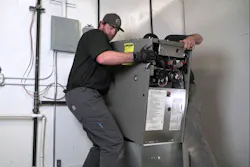
The HVAC industry’s labor shortage remains one of the most pressing challenges facing contractors today. As experienced technicians retire and demand for skilled labor continues to grow, contractors are finding themselves in a race to build the next generation of talent.
The need for HVAC technicians and installers is projected to grow 8% from 2024 to 2034, much faster than the average for all occupations, per the Bureau of Labor Statistics. Additionally, there will be over 40,000 job openings in HVACR each year, on average, over the next decade.
Increasingly, contractors are realizing they can no longer rely solely on trade schools and traditional apprenticeship pipelines to meet their staffing needs. Instead, many are adopting a “grow your own” approach by launching in-house training programs, partnering with community colleges, and creating company-run academies to accelerate technician development.
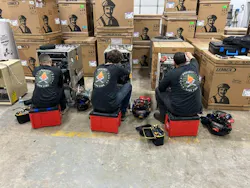
For Sila Services, headquartered in King of Prussia, Pennsylvania, launching an in-house training program was about more than filling open positions—it was a reflection of the company’s commitment to the trades. According to Edward McFarlane, chief learning and development officer, many companies talk about investing in training, but the real test comes when those investments impact the bottom line. Sila viewed workforce development as both a strategic business priority and a responsibility to the industry.
“This was always part of the DNA,” McFarlane said. “It was always a strategic goal, certainly, but also a corporate citizenship goal.” He adds that the company saw itself as a steward of the industry, committed to “leave it better than we found it” and give back to the trades that have fueled its success.
After roughly 18 months of planning and development, Sila launched its first training class in late 2024. “Like anybody else, I would encourage readers to do a pilot proof-of-concept class,” McFarlane said. The initial group allowed Sila to work through challenges related to timing, curriculum development, and program structure before expanding to new hires.
Sila University has graduated 44 students across its broader Project LiveFire pipeline, spanning multiple cohorts and regional launches, including New York/Connecticut, New England, KOP, and Virginia. LiveFire is structured as an 8-week program with 4 classroom days and 1 field day per week, with classroom and lab training typically running 8:30 a.m.-4 p.m., which equates to approximately 240 classroom hours and 60 field hours per student, or 13,200 total development hours. The program moves participants into field-ready roles, with EPA 608 and NATE CHP-5 as core credentialing outcomes.
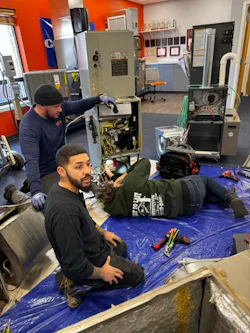
One might assume the biggest hurdle in launching an in-house training program is securing the equipment and finding the space. McFarlane says it’s actually identifying the right instructor. “Technical expertise alone doesn't guarantee someone can effectively train others,” he notes. “There's people who know, but they maybe can't teach. There's people who want to teach, but maybe not for the right reasons.”
He adds that the growing trend of contractors developing in-house training is largely driven by necessity. “It’s simply a lack of other options and an attempt to control your own destiny.” However, McFarlane cautions that contractor-run academies should be viewed as just one workforce development strategy rather than a cure-all. “It is one tool in your arsenal for workforce development,” he said. “The business plan should always dictate the use of it, not the other way around.”
While in-house programs can help accelerate onboarding and create technicians who are trained to a company's standards, McFarlane believes they should complement—not replace—traditional trade schools and vocational programs. “It shouldn't take place of the traditional hiring paths,” McFarlane said. “It's just one more on-ramp to get the right mix of people for your business.” Rather than competing with technical schools, contractor training programs can help bridge the gap between classroom education and field readiness.
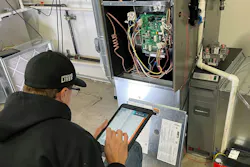
Barron Heating AC Electrical & Plumbing, a 54-year-old contracting business based in Ferndale, Washington, with roughly 200 employees, has also seen success through its Barron Technician School.
Brad Barron, CEO and partner of Barron Heating AC Electrical & Plumbing, saw the skilled labor shortage as a challenge the industry could no longer ignore. After hearing an EGIA presentation highlighting that “five baby boomers [are] out for every two millennials or Gen Zers entering the trade,” he began thinking about ways to create his own talent pipeline. The idea for an in-house training school came from an unexpected source—his wife, a high school science teacher. “She was like, ‘Hey, what if you just started your own school?’” Barron recalled. What initially sounded simple quickly evolved into a major undertaking.
The Barron Technician School ultimately became an in-house training program complete with dedicated classroom and lab space. Barron's wife played a critical role in its development, temporarily leaving teaching to help create the curriculum. “She’s got a master’s in teaching and curriculum development,” Barron said, noting that she worked alongside the company's service manager to build the program's 15-week educational framework. As the company grew and saw success with multiple training cohorts, other contractors began asking how they could replicate the model. That demand eventually led to the creation of Whole Home Academy, an extension of the company's broader Whole Home Alliance contractor network. “What we modeled at Barron, we're helping other contractors across the U.S. do right now,” Barron says. Today, the academy provides technical, sales, and leadership training while helping contractors launch their own in-house schools using the curriculum and best practices developed at Barron.
The Whole Home Academy helps contractors startup their own schools nationwide, with the latest addition in Chicago.
Barron admits that a training program requires a significant investment—roughly $10,000 to $15,000 per student over Barron’s 15-week curriculum—but he believes the key to success starts with recruiting the right candidates. "Making sure that we identify the right candidates that are core value aligned, hungry, humble, people-smart, passionate," he says, is just as important as the technical training itself. The company has refined its recruitment process over eight cohorts, attracting more than 30 applicants for just six available spots in its most recent class.

Barron found that some of the strongest candidates were career changers looking for a more rewarding profession. "There was a ton of interest of second careers," he said, noting that everyone from grocery store employees to automotive technicians and even Starbucks baristas have successfully entered the program. To ensure applicants understand the realities of HVAC work, candidates participate in ride-alongs before being accepted. "We've had people bow out a lot," Barron says. "They're like, 'Oh man, this is not what I thought it was going to be.'"
The Barron Technician School has now graduated nearly 40 technicians and boasts a retention rate exceeding 90%, results Barron credits to both careful candidate selection and a structured training process. Once accepted, students are asked to sign a two-year repayment agreement, stating they understand the value of the free education they are being offered, and agree to give Barron a minimum of two years following program completion. Graduates leave with a broad understanding of electrical systems, gas heating, refrigeration, controls, zoning, and specialty applications. The program has also achieved a 100% pass rate on NATE and EPA certification exams.
One of the school's unique features is that all technicians—even those destined for installation roles—begin with service training. Barron believes troubleshooting skills are essential as HVAC systems become increasingly sophisticated. That approach has paid dividends beyond workforce development. "It's actually helped to reduce our warranty callback rate in half," he says. By giving technicians a deeper understanding of diagnostics, controls, and system performance, the company has improved installation quality and reduced costly errors in the field.
While fast-track training programs have become more popular over the years, Barron argues that quality training requires patience. The company's goal is not to get technicians producing revenue as quickly as possible, but to build a strong foundation that leads to long-term success. "It's better to do it right than do it fast," he says. Although graduates typically require six to nine months before becoming fully independent technicians, Barron believes the investment delivers strong returns through higher retention, fewer callbacks, improved customer experiences, and a steady pipeline of skilled talent for the future.

The Case for Continuous HVAC Training
AI is changing everything in HVAC businesses, including training. Quinn is an AI-powered training platform that converts existing SOPs, training documents, videos, and manuals into short, gamified, mobile-friendly training courses that technicians can complete on their phones, helping contractors accelerate onboarding, standardize training, track progress, and improve knowledge retention across their workforce. Several contractors and technical schools already work with Quinn, including Universal Technical Institute, Goettle, and, most recently, Sila Services.
“We made the decision to partner with Quinn because we see a fundamental shift underway in how frontline teams learn and perform,” McFarlane says. “Traditional training models are still valuable, but they simply don’t all scale across a multi-location, multi-trade business. Quinn allows us to take the knowledge of our best operators and turn it into consistent, accessible, mobile-first training for every technician, in every market. As we move forward, our focus is on using the platform to accelerate onboarding, reinforce key behaviors in the field, and ultimately drive better outcomes for both our people and our customers.”
According to Arlen Marmel, COO and co-founder of Quinn, most organizations struggle to balance engaging, hands-on instruction with scalable training programs. “Most of our partners are training their folks in one of two ways,” he says. “Either human-led, which is really engaging but often hard to scale and inconsistent, or documents, slides, videos, SOPs—all these things that are really scalable, but not particularly engaging or effective.” Quinn was developed to bridge that gap by transforming existing training materials into mobile-first, interactive learning experiences.
The platform uses AI to convert SOPs, videos, manuals, and recorded training sessions into bite-sized courses that technicians can complete on their phones in as little as five to 15 minutes. The training includes role-playing exercises for customer service skills, technical simulations, and interactive knowledge checks designed to reinforce learning. Marmel says the goal is not to replace instructor-led training, but to augment it with consistent, ongoing education. “There’s nothing like putting your hands on a wrench,” he said. “But I think it’s not realistic to have your folks in training five days a week and not out in the field.”
One area where Quinn has gained traction is helping contractors train a new generation of employees, from recent high school graduates to entry-level workers. Traditional classroom-style training often fails to resonate with these learners. “Quinn can meet the learner where they are,” Marmel says. Because the platform is mobile-first, adaptive, and available in multiple languages, it can personalize training based on an individual's experience level and learning style. "Built-in AI tutoring capabilities also allow technicians to ask questions privately and receive real-time guidance without the pressure of speaking up in a classroom setting," he adds.
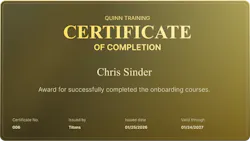
Another advantage is the speed at which companies can create and update training content. “We’re able to really help these organizations build their entire bespoke training library, effectively a trade school dedicated to their business in minutes instead of months,” Marmel explains. That capability is especially valuable as contractors adapt to new technologies, equipment, refrigerants, and regulatory requirements that require frequent retraining.
The platform also incorporates gamification throughout the learning experience. Courses feature interactive exercises, simulations, leaderboards, and competitive scoring that encourage participation and knowledge retention. “We can even create detailed 3D equipment models that allow technicians to explore components virtually and practice troubleshooting before encountering equipment in the field,” Marmel says. Combined with analytics that track completion rates, skill gaps, and knowledge retention, the system gives contractors greater visibility into workforce development efforts while helping ensure technicians receive the right training at the right time.
Where HVAC Education Goes From Here
For contractors considering launching a training program, the first step is recognizing that workforce development requires a long-term commitment, not a short-term expense. Marmel advises contractors to treat training as a strategic investment that begins on day one and continues throughout an employee's career. “You have to put real value on developing your people. You have to assign a budget,” he says.
Too many companies focus heavily on recruiting talent only to underinvest in onboarding, resulting in high turnover during the critical first 90 days. “We're not properly investing in them in the first 90 days, and we're losing 30-40% of that talent,” Marmel notes. The most successful organizations, he says, create clear career pathways that help employees understand how to advance while providing the training and support needed to get there.
Contractors also need to carefully evaluate the cost and complexity of building a training academy from scratch. “Do your research ahead of time, understand the investment if you're going to do it yourself,” Barron says. Rather than reinventing the wheel, he encourages contractors to explore partnerships with organizations that already have proven curriculum and training frameworks in place. Despite the upfront costs, Barron believes the return on investment is substantial, citing improvements in company culture, customer satisfaction, technician retention, and reduced callback rates.
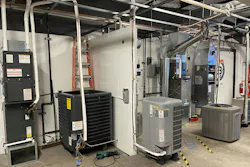
Both Barron McFarlane stress the importance of leveraging industry partnerships to reduce training costs and strengthen programs. McFarlane recommends working closely with distributors, manufacturers, and tool vendors to source training equipment, including scratch-and-dent units, returned products, and older systems that reflect what technicians encounter in the field. “Service techs work on old things,” McFarlane says. Barron echoed that advice, noting that manufacturers and distributors often have a vested interest in supporting contractor training efforts. “The more techs we have, the more units they move,” he adds.
Looking ahead, both experts believe contractor-led training will become increasingly common as labor shortages persist and technology continues to evolve. However, Marmel argues that companies should also embrace emerging tools that make training more scalable and effective. “AI has fundamentally transformed what's possible,” he says, pointing to the ability to create customized training content, assess skill gaps, and provide personalized learning experiences in a fraction of the time traditional methods require.
Whether through in-house academies, partnerships with technical schools, or AI-powered platforms, the common thread is a commitment to continuous learning. As Barron put it, “You have to invest in people in order to invest in your company.” For contractors seeking sustainable growth, workforce development is no longer optional—it's a business imperative.