How Hesse Heat and Air Built a More Recognizable HVAC Brand
Why It Matters
- A distinctive brand can help contractors stand out in crowded markets where service vehicles, logos and marketing materials often look alike.
- A rebrand does not have to mean abandoning a company’s history, because retaining a trusted name can preserve customer recognition while modernizing the business’s image.
- Simplifying a company name and visual identity can make the business easier for customers to find online, spell, remember and recommend through word of mouth.
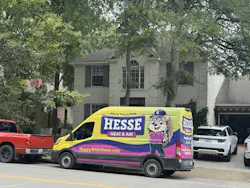
In a crowded HVAC market, delivering great service isn't always enough to make a company stand out. When contractors' trucks, logos, and marketing look alike, homeowners may struggle to distinguish one business from another — even when the quality of service sets it apart.
For Hesse Heat and Air, a family-owned HVAC company founded in 1972, that realization sparked a complete rebrand designed to build brand awareness, attract new customers, and support future growth. As General Manager and Comfort Advisor Noelle Henry explains, "We just realized that great branding could help more people discover that great service."
From Family Business to Growth-Oriented Brand
Henry's father, Tom Hesse, founded Hesse Heat and Air in 1972 while working as a facilities manager at Munster Memorial Hospital. Henry grew up around the business, later returning after college and starting in a part-time role that expanded into sales and leadership.
"He built this reputation through craftsmanship and service,” Henry says of her father. “And I've had the opportunity to help build that business and the brand around that reputation."
However, even a company with decades of history and loyal customers can reach a point where its visual identity no longer reflects its ambitions.
The decision to rebrand Hesse Heat and Air began at an industry conference, where a presentation contrasted a lineup of white service trucks with one brightly branded vehicle. When attendees were asked which truck they remembered, the answer was obvious. The example resonated with Henry and her brother, sparking the idea for a more distinctive brand identity. After considering a name change, the company ultimately returned to its roots with Hesse Heat and Air. “We didn’t just want a prettier logo,” Henry said. “We wanted a brand that was simple and recognizable to our long-term customers, but memorable to people that didn’t know us yet.” The goal, she explains, was to stand apart in a crowded market: “If you look like everybody else, it’s difficult for people to remember you.”
Emily Fleniken, co-founder and creative director of Lemon Seed Marketing, the agency behind the rebrand, notes that once you’re changing a business name, it’s not just a “refresh” anymore, but a full rebrand.
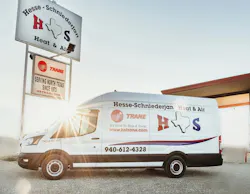
“The old name, Hesse-Schniederjan, was hard to say, hard to spell, and hard to Google,” Fleniken says. “That's not a logo problem, that's a ‘customers can't find you or refer you’ problem. And with everything going through the internet these days, if people can't spell your name to search for you, you're losing business you don't even know you're losing. So a small, incremental tweak wasn't going to cut it, they needed an overhaul.”
For Lemon Seed, the rebranding process starts with a competitive analysis to identify opportunities for HVAC contractors to differentiate themselves. Fleniken says the agency examines competitors’ colors, characters, taglines, and overall branding to determine whether a company stands out or blends in. With Hesse Heat and Air, the opportunity was clear: competitors relied heavily on red and royal blue, and few used mascots effectively.
“If a contractor's brand looks basically identical to five other trucks on the road, that's a red flag,” Fleniken says. She adds that outdated logos can also signal a company is resting on its history rather than growing and evolving. “If your branding doesn't show your personality or set the tone for what it's actually like to work with you, you look exactly like your competitors, so why would anyone pick you over the next guy?”
The agency also worked to balance modernization with the company's established reputation. Rather than discard decades of recognition, Lemon Seed recommended retaining the Hesse name while simplifying the company's identity. “We kept ‘Hesse’ — that name has decades of trust behind it since 1972, and there was no reason to throw that away,” she says. “We just cut the part that was tripping everyone up.” Simplifying the name made the business easier to find and talk about, reinforcing an important lesson for contractors: a successful rebrand should preserve the trust a company has earned while making it easier for new customers to recognize, find, and remember the business.

Introducing the Hedgehog
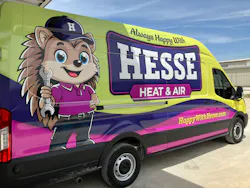
One of the most memorable aspects of the new Hesse Heat & Air brand is the giant hedgehog on the side of the trucks.
"HVAC can be pretty boring from a branding standpoint,” Henry says. “You see lots of flames, and you see lots of snowflakes and just everybody looks the same. We wanted to be different. Nobody expects an HVAC company to have a hedgehog."
Henry began exploring all animals beginning with the letter ‘H.’ That’s when she learned that hedgehogs prefer temperatures between 72° and 80°F, making the animal a natural fit for a home comfort business.
"We wanted something cute, memorable, unexpected, and connected to home comfort. And so Happie the Hedgehog works for us. Checked all the boxes," Henry says.

Fleniken says Henry came to Lemon Seed wanting a hedgehog mascot, so the agency took the idea and ran with it. “The name Happie, the alliteration with Happy and Hesse, all of it clicked together once we had that starting point.”
A mascot gives a home service company so much more to work with, Fleniken adds. “It's not just a logo sitting on a truck; it's headlines, it's social content, it's a costume that shows up at community events and takes pictures with people. It's memorable in a way a clean logo never quite is, and it gives the brand a personality people can actually connect with, not just recognize.”
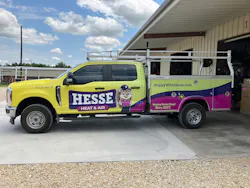
In addition to the new mascot, the company received new colors: magenta, navy, and lime, instead of the standard red, white, and blue everyone else was using; and a new tagline, “Happy with Hesse,” which doubles as a customer promise.

Managing the Fear of Change and Customer Reactions
A major challenge of any rebrand is concern about alienating long-time customers or losing the recognition the company had built over five decades.
“Rebranding is a risk, plain and simple,” Fleniken says. “You're going to get some pushback from a few negative nancies who don't love change, that's basically guaranteed for any market. But that's almost always outweighed by the positive buzz and excitement you get in return, both from customers and from your own team. There's also just the practical stuff like re-doing apparel, trucks, printed materials, signage... that's a real financial lift. But it's worth it because it signals growth and relevance instead of ‘same old tired company.’”
Hesse used a phased communications strategy to introduce the change rather than unveiling everything without warning, Henry explains.
“We teased the upcoming change on social media,” she says. “We sent letters to maintenance agreement members, mailed postcards and other direct-mail pieces to existing customers offering a special promotion tied to the rebrand. Our message was we weren’t changing the company. We were just changing the way the company showed up.”
Henry says most reactions the company received were positive, although some customers questioned the hedgehog and the new colors.
"It got your attention, didn't it?” Henry says, recounting her brothers' response to criticism. "If they're noticing you, remembering you, and talking about you, your brand's doing its job."
Lessons to be Learned
One of the biggest takeaways for Henry is that a rebrand takes time. “We actually just got one of the signs on our building done, and we've been rebranded for a year. None of it happens as quickly as you think it can, and it's just hard to get it all done. So, you don’t have to change it all in one day. It’s going to be fine — just keep moving forward and it will all work out.”
Henry says the company did not establish specific metrics tied directly to the initiative, making it difficult to quantify the rebrand's individual contribution. However, the company has noticed increased online engagement, more customer interactions and recognition of the brand, positive feedback about the vans and hedgehog mascot, and continued revenue growth, although the portion attributable to the rebrand is unclear.
"Can I say every dollar of that growth came from the rebrand? Of course not,” Henry says.
According to Fleniken, the best way to determine a successful rebrand is “when it creates actual chatter — people talking about it, excited about it.
“You want your existing customers feeling proud to be associated with your company and be a ‘raving fan,’ your team feeling rejuvenated and excited to wear it and post about it, and new customers finding you because the brand is finally memorable enough to stick,” she continues. “For Hesse, going all-in on the name, colors, and mascot at once created way more spark and buzz than a slow incremental change ever would have. All while keeping ‘Hesse’ in the name kept that transition smooth for a company that's been trusted since 1972.”
Henry says Hesse wants to deepen its community involvement and create more opportunities for people to encounter the brand before they need service.
“We're not finished building the brand. I don't think you ever really are,” Henry adds. "The goal is to continue expanding in ways to serve our customers while maintaining the level of service and professionalism that got us here."
For Hesse, the rebrand is not simply a change in colors or a new mascot. It is part of a broader effort to build awareness, support expansion, and make a decades-old family business more recognizable to the next generation of customers.
Want to hear more? Listen to Noelle Henry discuss Hesse Heat and Air’s rebrand journey, lessons learned, and the power of standing out in a crowded HVAC market on the HVAC Chats podcast.
About the Author
 Nicole Krawcke
Nicole Krawcke is the Editor-in-Chief of Contracting Business magazine. With over 10 years of B2B media experience across HVAC, plumbing, and mechanical markets, she has expertise in content creation, digital strategies, and project management. Nicole has more than 15 years of writing and editing experience and holds a bachelor’s degree in Journalism from Michigan State University.