One Combustion Safety Test to Avoid
Key Highlights
- Measuring CO in ductwork can give a false sense of security because it may not detect leaks or CO from other sources.
- Cracked heat exchangers often do not cause CO to leak into the airstream due to pressure differences, making duct tests unreliable.
- Proper diagnosis involves testing CO levels directly in the flue pipe, not just in the duct system, to accurately identify heat exchanger issues.
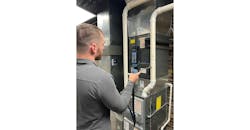
Many in the HVAC industry assume cracked heat exchangers are the leading cause of combustion safety issues. Unfortunately, this belief leads to inaccurate testing that you should avoid. Let’s look at one test that many believe is for finding cracked heat exchangers and how this test could mislead you.
Use a Combustion Analyzer for Combustion Gases
The test I’m referring to uses a combustion analyzer to measure carbon monoxide (CO) in the ductwork while the furnace is running. This test is a bad idea. It can leave technicians, contractors, and homeowners with a false sense of security. That’s because it ignores other potential CO sources and can leave a dangerous situation hidden in plain sight.
Well-meaning technicians install a test port (drill a hole) in the duct system and insert the combustion analyzer probe through the port. They typically let the furnace operate for five to ten minutes before taking a measurement. This test is to measure CO in the airstream. If a technician sees a reading of zero ppm, they assume all is well and the furnace is safe. The idea behind the test as a quick safety check makes sense, but like most things in our industry, it’s not that simple.
Chasing CO “Leaks”
Here’s the logic behind this test: if there’s a crack in the heat exchanger, air blowing through the ducts would contain CO from flue gases “leaking” into the airstream. So, if there is dangerous gas in the duct system, the combustion analyzer will pick it up and indicate a bad heat exchanger. Sounds good, right?
Unfortunately, a cracked heat exchanger might not cause flue gases to leak into the conditioned air stream. Sure, this test might measure any CO the furnace blower circulates, but it doesn’t identify the source of the CO. The technician still needs to determine the cause.
Imagine how you would feel if you performed this test and condemned a furnace because of CO in the duct system. Then, you install a replacement heat exchanger or new furnace, and on startup, you still measure CO in the ducts. This is a real possibility.
Two Testing Assumptions
Contractors typically make two assumptions with this test.
The first assumption is that any cracks in a heat exchanger allow flue gas to travel from the fireside to the conditioned airside. This reasoning sounds good, but the opposite interaction can take place. Conditioned air passing across the heat exchanger moves into the heat exchanger.
Here’s why: The fireside (inside) of a heat exchanger is under negative pressure. That’s because the induced draft blower assembly “pulls” air through the heat exchanger to overcome its pressure drop. The highest positive air pressures in the HVAC system surround the airside (outside) of the heat exchanger. In other words, static pressure outside the heat exchanger is greater than inside it. You can measure these pressures for yourself with a manometer. Don’t take my word for it.
This interaction between the airside and fireside of a heat exchanger is one reason manufacturers have rollout switches near the burners in modern furnaces. If a crack occurs, the additional heat trips the switch because of blower pressurization. Older natural draft furnaces didn’t have these safeties, and you ended up with melted wiring and flame rollout.
The second assumption is that CO levels from flue gas will appear on the combustion analyzer display. For this response to happen, flue gas CO levels must be dangerously high, a very rare situation because when two airstreams mix, dilution occurs. Remember, a residential furnace blower moves a lot more air than the amount of flue gas the furnace produces. Also remember that higher pressure goes to lower pressure.
Test the Right Way
Sometimes a cracked heat exchanger produces excessive CO levels. The blower air causes the flames to impinge or contact surfaces they shouldn’t. This interference causes high CO readings in the flue gas, not in the conditioned airstream. So, you cannot pinpoint this problem testing in the duct system.
Remember, the absence of CO in the air stream doesn’t necessarily mean the equipment is safe. You could have a furnace producing 10,000 ppm+ of CO in the flue gas and measure zero ppm in the airstream. This is why combustion testing the right way is so important.
To discover impingement and verify equipment safety, measure CO in the flue pipe with a combustion analyzer. You may need to install a test port in the flue, depending on the equipment type. Insert the analyzer probe before the draft hood or draft control on natural draft equipment, and in the flue of fan-assisted and condensing equipment. If you measure CO over 100 ppm in the flue or the CO readings continue to rise, you need to investigate further. Be sure to seal the test port with a proper plug after testing is complete.
In addition, be sure you identify other potential CO sources. When you narrow your focus to just the furnace, you overlook other potential sources such as water heaters, gas ovens, and attached garages. You can’t test the space all the time, so it’s always best to recommend a low-level CO monitor so your customers have the best protection available.
Just to make sure I’m clear, cracked heat exchangers are never acceptable. They are mechanical failures that need correction. But if you find a cracked heat exchanger, please don’t replace it without first identifying the cause. Instead, be a thorough troubleshooter and uncover the true reason for failure. Otherwise, the problem will show up again.
About the Author
 David Richardson
David Richardson
Director, technical curriculum
David Richardson is the vice president of training at National Comfort Institute, Inc. (NCI), Avon, Ohio. NCI specializes in training that focuses on improving, measuring, and verifying HVAC and Building Performance.