Before Blaming the HVAC Equipment, Look for the Real Cause of the Callback
Why It Matters
- Understanding building pressure can help contractors diagnose difficult callbacks faster and avoid unnecessary equipment changes or refunds.
- The case demonstrates why proper commissioning and comprehensive diagnostics should go beyond checking refrigerant charge, airflow, and electrical components.
- Attic fans and other ventilation equipment can significantly affect HVAC performance, making it important for contractors to consider how the entire building interacts with the HVAC system.
It’s never a good day when you get a callback on a new installation. It’s even less appealing during the summer heat.
Last year, my friend Gio installed a new furnace and air conditioning system in a house that was built sometime between the 1960s and 1970s. The lady who owned the house was in poor health, so all the communication had to go through her children.
Gio ran a Manual J load calculation on the home and determined the house had approximately a 30,000 Btu heat gain. The job went smoothly, and after walking her children through what they did, he had another happy customer. That is until the cooling season started.
The First Heat Wave
We have all had those days when everything seems to hit at the same time. Usually, it happens when the outdoor temperature is brutal. The phone rings non-stop from customers wanting someone out as soon as possible, and then you get hit with a callback. There is nothing worse than getting called out to a job you already got paid for (that isn’t working) during the money-making season.
Gio sent one of his service technicians back to the house to diagnose why their new system wasn’t keeping up.
When the tech arrived at the home, he noticed that the air conditioning was running. The first thing he did was go down into the basement and check the air filter, which looked brand new. He then made his way outside to the condenser and waved his hand over the fan to feel the discharge air temperature. It was hot.
Could there be an electrical problem with the unit, causing an intermittent issue? He dove in deep and checked everything he could think of. Now he was questioning whether the installers had commissioned the system properly. So, he measured fan airflow and then checked the refrigerant charge.
That was when he decided to call for help. There was absolutely nothing wrong with the equipment. This was the point at which they wondered if someone had made a mistake with the load calculation. Could the new equipment be too small for the house? They reluctantly told the customer to let it run for a few days to see if the indoor temperature improved.
From Bad to Worse
A few days passed, and the outdoor temperature and relative humidity both increased. The phone rang again, and this time the daughter was irate. She screamed, “My mom’s house is extremely hot, and now the drywall in the bathroom is dripping water from the ceiling. We see mold starting to grow!”
The lady’s daughter had already spoken to an insurance adjuster. He had met her at the house and inspected the new air conditioning installation. The adjuster noticed the evaporator coil was a half-ton larger than the condenser and concluded the “mismatch” was the reason they were having extreme humidity issues in the home. He also assumed it was why the new equipment wasn’t cooling and recommended they sue the contractor.
Having a mismatched system could create serious capacity issues, but Gio had hand-selected an AHRI-matched system. Needless to say, he was still nervous when she relayed the findings. Gio didn’t miss a beat and drove straight over to the house.
Walls Shouldn’t Sweat
On the way to the house, Gio had all sorts of thoughts racing through his head. What could the problem be? The one thing he was certain of was that he was going to have to look at everything.
He started in the crawl space and noticed that someone had spray-foamed the rim joist. He looked all over to see if there was some kind of connection to the outside. And that was when it hit him, literally. A drop of water hit him directly on the forehead. The ducts were sweating terribly. He also found biological growth on the joists and the subfloor.
Next, he looked in the mechanical room and noticed that there was water coming out of the chimney cleanout. The bathroom wasn’t much better. There was mold already growing all over the ceiling, and there were small puddles of water on the tile floor from the dripping water.
Not a FAN of Attics
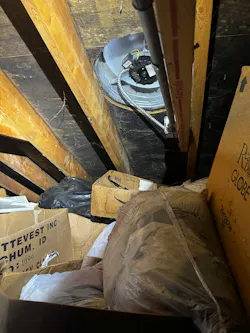
As a last-ditch effort, Gio grabbed his ladder to take a peek in the attic. It was quite a surprise when he climbed into the attic and realized it was 78°F in a vented attic on a 90°F Day.
How could this be possible? Attics are supposed to be hot! But this one wasn’t. There was something out of place. Is that a new attic fan?
When Gio measured the attic pressure with reference to (WRT) the house, he found an extremely depressurized attic. He asked the customer when they installed the attic fan, and she said, “Just recently. My son-in-law installed one in both of the attics.”
Gio measured the house pressure WRT outside and found the house was -10 Pascals!
The attic spaces did not have adequate vent inlets. These fans were so powerful they were literally sucking the air-conditioned air out of the house and into the attic through all connections. The bath fan was the biggest connection. It was the reason for the wet ceiling. Since the house was in a vacuum, hot/humid air leaked into the home from any opening it could find.
Gio advised his customer to unplug both attic fans. The temperature and relative humidity in the house started to drop rapidly. This was a great catch on his part. I think many companies would have given her a refund or installed a larger system.
The moral of this story is sometimes the HVAC equipment isn’t the problem. In this case, attic fans, inadequate intake venting, and leakage between the house and attic all combined to create the failure. The son-in-law installed the fans with good intentions but without an understanding of pressure, airflow, and building interactions. He did not know what the trickle-down effect was going to be.
About the Author
 Adam Mufich
Adam Mufich
content developer and instructor
Adam Mufich serves the HVAC industry as content developer and instructor for National Comfort Institute, Inc. (NCI). NCI specializes in training that focuses on improving, measuring, and verifying HVAC and Building Performance. Find them at www.nationalcomfortinstitute.com.