Construction Employment Growth Slows Despite Low Unemployment Rates
Key Highlights
- Construction unemployment rates stayed below 10% in all U.S. states in September 2025.
- The national construction unemployment rate was 3.8%, up slightly from the previous year.
- 21 states had lower unemployment rates than in September 2019, while 27 states experienced higher rates.

WASHINGTON — Construction unemployment rates remained below 10% in every U.S. state in September 2025, according to a state-by-state analysis released by Associated Builders and Contractors using U.S. Bureau of Labor Statistics data.
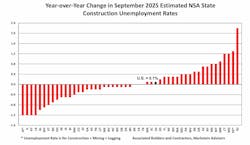
The national non-seasonally adjusted construction unemployment rate was 3.8%, a 0.1% increase compared with September 2024. Twenty-six states recorded lower construction unemployment rates than a year earlier, while 21 states posted higher rates and three states — Alaska, California, and Texas — were unchanged.
Payroll construction employment increased by 33,000 jobs compared with September 2024. Seasonally adjusted construction employment reached 8.3 million, or 9.1% above its pre-pandemic peak of 7.6 million. However, year-over-year employment gains have slowed, marking the third consecutive month with growth below 100,000 after several years of larger increases.
Comparisons with pre-pandemic levels showed mixed results across states. As of September 2025, 21 states had lower construction unemployment rates than in September 2019, 27 states had higher rates, and Arkansas and Washington reported the same rate.
Among the states, Oklahoma posted the lowest estimated construction unemployment rate at 1.4%, followed by Hawaii at 1.7% and New Hampshire at 2%. Georgia, Indiana, and Tennessee were tied at 2.2%. New Jersey recorded the highest rate at 9.4%.
ABC noted that higher materials, insurance, and labor costs, combined with ongoing skilled labor shortages, continue to weigh on the construction industry, even as interest rates have eased following recent shifts in Federal Reserve policy.
Visit abc.org/economics for the Construction Backlog Indicator and Construction Confidence Index, plus analysis of spending, employment, job openings and the Producer Price Index.
Note: This piece was created with the help of generative AI tools and edited by our content team for clarity and accuracy.