Commercial HVAC Market Projected to Reach $113.05B by 2035
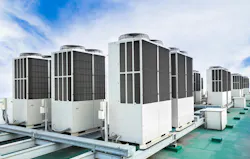
NEW YORK — The global commercial HVAC market is projected to grow from $52.50 billion in 2026 to $113.05 billion by 2035, representing a compound annual growth rate (CAGR) of 8.90%, according to a new report from Market Research Future.
The market was estimated at $48.20 billion in 2025. The report attributes the projected growth to building decarbonization initiatives, energy efficiency requirements, data center construction, and increasing attention to indoor air quality and occupant health.
HVAC equipment accounted for 57.8% of commercial HVAC market revenue in 2025, reflecting continued spending on cooling infrastructure and control upgrades, according to the report.
Data center construction is a significant source of expected demand. The report identifies data centers as the fastest-growing commercial HVAC application segment, driven by the expansion of cloud computing, artificial intelligence, and digital transformation. Healthcare facilities also require specialized HVAC systems for infection control.
Several technology trends are shaping the commercial HVAC market. The report points to increasing adoption of low-GWP and natural refrigerants, heat pump technology, smart controls, Internet of Things sensors, and artificial intelligence-based optimization. Modular and prefabricated HVAC systems are also emerging as a trend for faster installation and reduced costs.
Advances in compressor and heat exchanger design, variable-speed drive technology, advanced filtration, energy recovery ventilation, demand-controlled ventilation, and thermal energy storage are also contributing to system efficiency. Building automation and energy management platforms are enabling broader system optimization, according to the report.
Regulatory requirements are another factor influencing commercial HVAC investment. Building energy codes and efficiency standards, including ASHRAE and International Energy Conservation Code (IECC) requirements, are driving equipment upgrades. Refrigerant phase-down regulations, including the American Innovation and Manufacturing (AIM) Act and Kigali Amendment, are accelerating the transition to lower-GWP refrigerants.
The report also identifies challenges for the commercial HVAC industry. High capital costs for upgrades and replacements, complex system design and installation requirements, and the transition to new refrigerants and technologies can create training and compatibility challenges. Supply chain disruptions and material costs also affect manufacturing and installation economics.
At the same time, the report identifies opportunities in data center cooling, building decarbonization, energy efficiency upgrades, smart controls and building automation, and commercial heat pump adoption.
North America is currently the largest regional commercial HVAC market, with the United States leading the region. The report cites building decarbonization initiatives, data center expansion, equipment replacement, the Inflation Reduction Act, and energy efficiency programs as factors supporting U.S. market demand. Asia-Pacific is identified as the fastest-growing regional market, driven by urbanization, commercial construction, and data center expansion.
The report projects continued commercial HVAC demand through 2035 as building owners address efficiency, decarbonization, occupant health, aging infrastructure, and expanding data center capacity.