Midea Introduces Ceiling-Mounted “Pancake” Air Handler for Multifamily HVAC Design
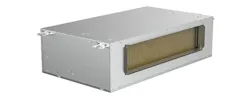
Midea announced its new inverter-driven Pancake Air Handling Unit (AHU) as an easy-to-install ceiling-mounted ducted ‘pancake’ solution that brings cold climate heat pump performance into a category historically dominated by fixed-speed systems.
The system is designed to deliver stable, high-performance heating and cooling across a wide range of climates, including cold-weather conditions. The Midea Pancake AHU is sized for convenient in-ceiling installation and is available in four capacities: 18K, 24K, 30K, and 36K, supporting a range of multifamily unit configurations.
The Midea Pancake AHU successfully combines inverter technology and enhanced vapor injection to support stronger cold-climate operation and empowers designers and developers to transition from fixed speed operation to more energy-efficient inverter-driven control.
The system delivers up to 100% heating output at -4˚ F, and continuous operation down to -22˚ F.
The Pancake AHU also supports auxiliary heat integration, providing backup capacity and added confidence for cold-climate applications.
It is also designed to simplify installation and integration in both new construction and retrofit projects. The system works within existing building infrastructure without requiring major system redesign.
Key installation and integration features include:
- Compatibility with standard 24V and RS-485 controls;
- Integration with a range of third-party outdoor units;
- Support for ducted distribution across multiple rooms from a single unit; and
- High cfm output up to 899 to support longer duct runs and complex layouts.
This flexibility allows specifying engineers to incorporate the system into a wide range of multifamily applications while reducing installation complexity and project disruption.
As multifamily development continues to prioritize space efficiency and higher-density layouts, HVAC system design is becoming a critical factor in overall project value. Installed within the ceiling, the system shifts HVAC equipment out of the occupied living space while maintaining ducted heating and cooling performance. The ultra low-profile design helps accommodate ceiling space constraints and existing building systems, including ductwork and fire protection layouts. This configuration eliminates the need for a dedicated mechanical closet, and keeps equipment concealed from primary living areas.