New York’s HFC Leak Reporting Rule: What Contractors Need to Know
Key Highlights
- NY's amended Part 494 regulation requires commercial property owners to register refrigerant equipment and report leakage starting in 2026, focusing on reducing greenhouse gas emissions.
- Contractors can support clients by offering registration assistance, leak testing, and recordkeeping services, positioning themselves as trusted advisors in sustainability efforts.
- The regulation encourages the adoption of newer, low-GWP refrigerants and aligns with broader goals of decarbonization and electrification, though it presents challenges for managing increased refrigerant use.

As part of the ongoing implementation of New York State’s Climate Act, the New York State Department of Environmental Conservation (DEC) has adopted an amended Part 494 regulation on hydrofluorocarbons (HFC), the greenhouse gases often used in refrigeration and cooling equipment. To comply with the regulation, commercial property owners with at least one large or medium-size piece of equipment that utilizes refrigerant must register the equipment on a state platform and begin reporting on leakage in 2026.
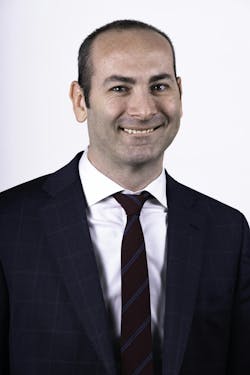
To understand the practical implications of this new mandate, Contracting Business sat down with Tristan Schwartzman, a principal and the director of energy services at Goldman Copeland, the New York City-based consulting engineering firm. The following is our exchange.
CB: What is the intent behind New York State’s amended Part 494 HFC regulation, and why is DEC focusing so heavily on refrigerant leakage now?
TS: The intent is to quantify and reduce the leakage of refrigerants. In the early 1990s, restrictions were placed on the use of R-11 refrigerants, and later on R-22 refrigerants. The questions now are: What refrigerants are being used? How much is being used? And how much is released into the atmosphere through leakage? Understanding this will enable the State to shape policy to control its effects.
CB: Which types of commercial buildings and property owners should be paying closest attention to this regulation—and who might be surprised to find they’re covered?
TS: Owners and managers of buildings in New York should be paying attention if any of their buildings has a main chiller plant or a large packaged air conditioning unit or a variable refrigerant flow (VRF) system. They should check the nameplate on the chillers or AC units, as that will indicate how many pounds of refrigerant are in the equipment. For more complicated systems, including VRF, they should seek expert advice. For larger building owners, this should be relatively straightforward and within their competence. But, a wide range of smaller buildings could still trigger the requirements, including multi-family buildings with chiller plants, religious institutions, and larger retail spaces. Additionally, some larger commercial tenants may trigger the requirements with their own independently operated equipment.
CB: How does the DEC define “large” versus “medium-size” refrigerant equipment, and what are some common real-world examples contractors encounter in the field?
TS: Beginning in March 2026, owners must report annual refrigerant leakage rates for registered “large” equipment: 1,500 pounds of refrigerant or more, typically chillers of about 500 tons of capacity or more. Large equipment would include, for example, steam turbine chillers or a main chiller plant for a high-rise building.
By June 2026, owners will be required to register any “medium-size” equipment — from 200 pounds of refrigerant up to 1,499 pounds, which could include units as small as 40-50 tons of capacity — and must report annual leakage rates by March 2027. Medium-sized equipment would include modular chillers or packaged air conditioning units that cover one floor. To determine how many pounds of refrigerant are in a chiller or packaged AC unit of certain refrigerant tons, our analysis shows that 1-3 pounds per refrigerant ton is a good estimate. For VRF systems, the comparable is 4+ pounds per refrigerant ton.
By June 2028, “small” equipment — from 50 pounds to 199 pounds — must be registered.
CB: What does the registration process look like in practice, and what challenges are you seeing owners face when trying to inventory and register their equipment?
TS: The registration takes place through an online form on the NYS DEC platform and is relatively straightforward. For each piece of equipment, it requires identifying information for the unit and its components, including model number, serial number, and a photograph of the registration plate. To fulfill the form’s requirements, one would need some understanding of chillers, packaged units, and VRF systems — and how many evaporators, condensers, compressors, and expansion valves there are. The technical details will be challenging for smaller owners and those trying to complete the documentation independently.

CB: For large equipment owners reporting leakage beginning in March 2026, what data needs to be tracked now to avoid scrambling later? What service records or refrigerant logs should contractors standardize starting today?
TS: What’s needed are any maintenance or service invoices for the previous year and any invoices for refrigerant bought for the relevant units. It’s best to keep a list of refrigerant purchases and a log of refrigerant added to systems — and to note which refrigerants were purchased, itemized by unit. It’s also important to know what refrigerant is in storage. Many buildings have clear procedures for electronically documenting this information; those that don’t should consider enhancing their preventative maintenance programs.
CB: Leak rate reporting is new for many owners. How is “annual refrigerant leakage rate” calculated, and what are the most common mistakes you anticipate?
TS: Generally speaking, any refrigerant added to the system is the equivalent of what has leaked. Thus, the total leakage should simply be the amount of refrigerant purchased. Issues will be with adequate tracking and documentation of refrigerant purchased.
CB: What role do service contractors and engineers play in helping owners stay compliant, especially when it comes to documentation, tracking refrigerant usage, and recordkeeping?
TS: At Goldman Copeland, we have created a service in direct response to the new Part 494 mandate. Through this service, we conduct an initial survey of a commercial property owner’s refrigeration and cooling equipment, determine what equipment meets the state’s definition of large or medium-sized, register the equipment as required on the state platform, and provide the mandated periodic monitoring and reporting. The initial survey typically takes 2-3 hours per site. Service contractors can provide similar services, including repairing the equipment and refilling the refrigerant.
CB: What new services or maintenance agreements could contractors offer to support ongoing compliance?
TS: They could offer the service cited above. They could also offer leak tests on larger equipment or other methods of quantifying leakage. Regular leak testing could be incorporated into preventative maintenance programs and could have the added benefit of improving overall system performance.
CB From your experience, how might this regulation change service practices, maintenance planning, or refrigerant management strategies for large and medium-size systems?
TS: This mandate will give both the owners and the State insight into the extent of use of refrigerants and how much potential for carbon emission from leakage there is. It will then encourage a shift to newer equipment with refrigerants that have lower Global Warming Potential. The application of this mandate to medium-sized and small equipment will create a greater challenge, since there is so much more equipment of that size.
CB: What are the potential cost implications for owners—both for compliance and for non-compliance—and how should contractors help communicate that risk?
TS: Owners who fail to comply with the regulation will be liable for a civil penalty of not more than $2,500 for each such violation and an additional penalty of not more than $500 for each day that the violation continues. The cost of non-compliance can then be compared to the cost of hiring a contractor or an engineering firm to address the mandate. The cost of compliance will be dramatically less than the cost of non-compliance. The price differential will make the case, so contractors need to provide information on the regulation to their clients.
CB: How does this regulation intersect with broader decarbonization goals, electrification efforts, or refrigerant transitions already underway in New York City?
TS: The Part 494 mandate is the next iteration of all three: first, it quantifies the carbon emissions from leakage with the aim to reduce it; second, with increased electrification there will be more refrigerant, so the potential for leakage will be greater; third, it will accelerate transitions to equipment using new refrigerants. It’s worth noting that the broad push for the electrification of heating equipment across the city and state will result in a large increase in refrigerant and associated refrigerant leakage. This will significantly offset the carbon benefit of electric heating, so quantifying the impact is essential to understanding how appropriate electrification is as a long-term solution, at least until low-GWP refrigerants are broadly available.
CB: What proactive steps should contractors be taking right now to position themselves as trusted advisors as these reporting requirements roll out?
TS: Contractors should contact owners to let them know about the new mandate and the potential fines for non-compliance, and they should ensure that owners are planning to address it.
About the Author
 Nicole Krawcke
Nicole Krawcke
Nicole Krawcke is the Editor-in-Chief of Contracting Business magazine. With over 10 years of B2B media experience across HVAC, plumbing, and mechanical markets, she has expertise in content creation, digital strategies, and project management. Nicole has more than 15 years of writing and editing experience and holds a bachelor’s degree in Journalism from Michigan State University.