The Rising Demand for Heat Pump Water Heaters
Key Highlights
- Heat pump water heaters can reduce energy use by up to 80%, significantly lowering utility bills for homeowners.
- Installation requires adequate space and proper placement to ensure optimal performance and condensation drainage.
- Many models include smart controls and leak detection, enhancing safety and enabling participation in utility demand response programs.
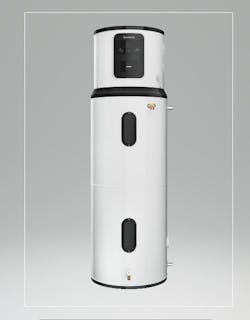
In an age of advancing technology, homeowners demand a lot from their appliances. Heat pump water heaters, which have been steadily growing in the United States for the past few years, deliver durability, low maintenance, flexibility, efficiency, and substantial cost savings.
“The efficiency of heat pump water heaters, not having to rely on fossil fuels, and rebates are the primary messages when we discuss heat pump water heaters with our customers,’’ says Victor Pedranti of Pedranti Mechanical in Brockton, Massachusetts. “It’s a nice piece of equipment.”
Heat pumps have historically been more popular in Europe than they have been in U.S. homes. That trend, however, is changing. An article in Rewiring America in 2023 found that just 1% of U.S. homes use electric heat pump water heaters for hot water. Data indicates, however, a growing market shift toward more energy-efficient water heaters. Some estimates project annual sales of heat pump water heaters topping three million units in the future.
For contractors, convincing homeowners they can find substantial savings by switching to a heat pump water heater should be simple. There are some important details that contractors and homeowners need to know before making such an important decision.
Energy Savings
While models vary, heat pump water heaters deliver substantial energy savings.
The key figure when evaluating HPWHs is the efficiency rating using the Uniform Energy Factor (UEF). Tier 1, as evaluated by the Consortium for Energy Efficiency (CEE), meets the minimum ENERGY STAR requirements. Tiers 2, 3, and 4 represent increasing levels of efficiency beyond the ENERGY STAR minimum. A UEF of 3 or better will offer long-term savings, but some models deliver a 4.01 UEF.
A real-world example to help illustrate the impact of heat pump water heaters: A typical family of four can see up to an 80% reduction in energy use when switching from a standard electric water heater to a heat pump model. Because a HPWH can ramp up during periods of high demand and then switch into more efficient operating modes when hot water needs are lower, it delivers significant energy savings throughout the day.
To put this into dollars, an 80% reduction in energy use means that for every $100 a homeowner spends on water-heating energy with a traditional electric unit, they would spend only about $20 with a heat pump water heater — while getting the same amount of hot water.
This efficiency advantage is reflected in the Uniform Energy Factor (UEF). A high-performance HPWH with a UEF of 4.0 delivers roughly four units of hot-water energy for every one unit of electricity it consumes. In contrast, a typical electric resistance water heater with a UEF of 0.90 converts electricity to hot water much less efficiently, delivering less than one unit of usable energy per unit consumed.
Switching from a standard electric or gas water heater to a heat pump model will save homeowners money. The exact amount of savings will depend on several factors: cost of energy, energy consumption, and energy factor.
Electricity costs in the homeowner’s community will influence the amount of savings. Electricity costs are measured in cents per kilowatt hour ($/kWh). For example, homeowners who reside in states with higher electricity costs – Hawaii’s cost is 42.27 per kWh, the highest in the nation -- will see a higher dollar savings, and a quicker pay-back after installing a HPWH, vs a location with a lower cost per kWh.
Total savings will also be dependent on how much energy is used within the household. The Department of Energy reports that the average heat pump water heater uses 2,195 kWh per year, but water use and household size will impact that figure.
“Homeowners are always concerned about the operational costs and maintenance,’’ Pedranti says. “Heat pump water heaters require very little maintenance, and they are much more efficient than a natural gas water heater. For the average home, here are some huge rebates available.”
Contractors will need to determine if a HPWH is the best option for their customers. A HPWH requires open space (recommended 750 square feet) to maximize efficiency and is best placed in an area where cool air exhaust won’t be a problem, like a basement or utility room. HPWHs need to drain condensation, so this will also be a factor when considering install location.
Additional Benefits
Many heat pump water heaters are engineered to last at least 10 years and require very little maintenance. Hybrid heat pumps use backup electric resistance elements to ensure a consistent supply of hot water, especially during high demand or when temperatures are too low for the heat pump to work efficiently.
Heat pump water heaters can also reduce the homeowner’s carbon footprint. Replacing a gas water heater with an HPWH can reduce annual carbon emissions by one ton, according to the Advanced Water Heating Initiative. According to ENERGY STAR, that’s the equivalent of 17 trees.
Some HPWH’s have built-in leak detection and meet or exceed the strict standards of efficiency that are required in some states.
Also, some HPWH models are also equipped with “smart” controls that enable customers to take advantage of utility demand response programs. These programs play an important role in the operation of the electric grid by reducing or shifting their electricity usage during peak periods.
Retrofit Requirements
Homeowners who are considering making the switch also need to be aware that some minor remodeling may be required.
Heat pump water heaters are taller than traditional gas or electric water heaters because the heat pump head sits on top of the storage tank, and they require more space than most gas or electric water heaters. If the existing unit is located in a basement, the homeowner might not need to create additional space. If, however, the existing unit is placed in a closet where space is constrained, the contractor might need to relocate the unit to accommodate the additional requirements.
“The biggest challenge can be the size,’’ says Pedranti. “They are a large piece of equipment. Ariston models have multiple water connections which provide options for piping, which is a nice benefit.”
Back to School
Even with the significant savings in energy costs, contractors may find some homeowners reluctant to switch. “Not everyone is willing to embrace new technology,’’ Pedranti says. “Even though they will save money in the long run, some people will be reluctant to switch.”
The education piece is an essential part of the conversion equation. It’s especially important to stress the advantage of incentives. Tax credits and rebates are still available in many states and can drastically reduce the out-of-pocket cost. In Washington state, for instance, Clark Public Utilities offers the highest incentives for its heat pump water heater rebate program, now up to $1,500. The previous high was $1,000.
It’s also important that homeowners understand that in the next few years, they might not have a choice. There is no debate, heat pump water heaters are the future. The heat pump water heater market, now around $549 million, is expected to grow at a rate of 11 percent to $1.62 billion by 2034.
One thing to watch for in the water heater market is the impact of NACEA4. Finalized in 2024 by the U.S. Department of Energy, the rule requires that as of May 2029, all electric storage water heaters with capacities greater than 35 gallons must be hybrid heat pump models to meet new efficiency standards. The DOE estimates these changes will save U.S. households billions of dollars annually on energy bills.
About the Author
Chuck Rohde
Chuck Rohde is the product director, water heating, for Ariston USA.