Smart HVACR Systems and the Evolving Role and Training of the Technician
Key Highlights
- AI-enabled HVAC systems provide real-time data and diagnostics, improving troubleshooting efficiency but still require critical human judgment.
- Training programs are evolving to include hands-on experience with smart equipment, IoT connectivity, and companion apps, though gaps remain in practical app training.
- Technicians need to maintain core mechanical knowledge while developing digital skills to adapt to increasingly complex, connected systems.
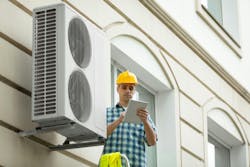
The era of smart HVACR systems is about a decade old. AI and other new technologies continue to change how HVACR technicians diagnose and troubleshoot systems. This leads to multiple questions, including: Do technicians need new skills? Are their previous skills relevant? How have training programs evolved to prepare technicians for the new systems?
AI Helps Technicians Diagnose Issues
In the past, a technician would arrive at a client’s house. Diagnosing the HVACR issue meant the technician would take measurements, do manual calculations, and consult manuals.
Today’s smart HVAC systems come with companion apps that provide an accessible, up-to-date knowledge base to support guided troubleshooting and consistent best practices among technicians. They also provide HVACR technicians with tons of data, and software aggregates it very quickly to understand how a system is operating.
The smart AI-enabled systems provide technicians with deeper visibility into active faults, likely failing components, and potential replacement needs when they arrive on-site. The new systems are shifting technicians toward more data-driven, efficient diagnosis and troubleshooting, using rich real-time system data rather than trial-and-error.
However, it’s not about simply following the diagnostic tools.
“AI-powered diagnostic tools can suggest probable causes, but they may lack the full context a technician gains on-site, such as installation quality, environmental factors, or subtle system behaviors,” said Bosch Product Manager Pulkit Aggarwal.
“You can't 100% rely on the AI,” says ECO HVAC trainer, Brandon Payne. “You still have to be a critical thinker.”
Payne argues that today’s techs need to have more mechanical knowledge.
“There's so many data points that we're measuring that we didn't in the past,” Payne said. “While technicians have access to AI-driven answers to their questions, they still have to critically think and separate the good from the bad answers. They need to have the right questions, because AI is an answer engine.”
How do they formulate the right questions?
“A strong grasp of core HVAC principles — refrigeration cycle, airflow, and system sequencing — remains foundational for commissioning and troubleshooting, even when software adds more visibility,” Aggarwal said.
It empowers technicians to validate or challenge automated recommendations rather than blindly follow them. This is necessary as today’s systems are more complex and expensive.
“The new systems are harder to work as there are a lot more moving pieces, and there's a lot more to break,” Payne said. “Parts are primarily factory-specific, so techs need to know where they can get a particular piece of equipment or have the right resources to ask questions.”
Ultimately, techs need to ask questions that may be humbling for veterans and uncomfortable for those who grew up relying on technology. No matter their background, HVACR techs will work on something they’ve never seen before.
Training Today’s Technicians
Although there are currently fewer smart HVAC systems operating in the United States than traditional systems, their market is growing and is projected to continue to do so moving forward. Therefore, training programs need to adapt to ensure technicians have the skills to work on the systems.
To get to that level, potential techs need training. Typically, training programs lag behind developments in the field.
“Training programs have evolved to include hands-on training with live smart and connected HVAC equipment, demonstrating how IoT data and newer diagnostic tools make technicians more efficient and accurate,” Aggarwal said. “In parallel, curricula now incorporate demos of companion apps.”
Payne agrees that training programs have evolved, but believes that they have a way to go. “Many labs are still using the old analog gauges while the better programs are building connected labs where students use smart thermostats, Bluetooth tools, and platforms like MeasureQuick on real equipment.”
Aggarwal also notes there are gaps in training, including “limited hands-on training with specific apps and IoT connectivity in traditional programs. There is also insufficient focus on validating AI outputs versus blindly following them, which can lead to potential misdiagnoses.”
Yet, those newbies who are properly trained to use the technology and have a strong understanding of mechanical and electrical fundamentals are a step ahead of previous generations.
“AI-enabled tools accelerating learning and boosting productivity, new technicians can ramp up faster, perform at a higher level sooner, and ultimately strengthen the talent pipeline, resulting in a net positive for the industry,” Aggarwal said.
Of course, veteran HVACR technicians need to update their skills as well.
And if they don’t update their skills?
“They can do the job effectively, but not as effectively as the guy that's been doing it one year who's using the tool,” Payne. “The experienced tech would be a disadvantage because the tools are such a force multiplier.”
He continues, "On the flip side, if the veteran can really embrace the tools and use them well, they're like a superhero in a lot of ways.”
The growth of smart systems is not only impacting today's new techs but also the workforce of tomorrow. Smart systems and the tools used to diagnose them are proving to be a boon for recruitment. Attracting more talent to the industry is essential, given that today’s HVACR employees are on average over 40 years old.
“The younger generation is really drawn to the fact that they're not just laborers, but technicians who are using state-of-the-art technology,” Payne said.
Moving forward, HVACR technicians will continue to need a diverse skill set to successfully serve customers.
“The most successful HVACR technicians will be hybrid experts who seamlessly blend deep mechanical knowledge with digital fluency in apps, AI assistants, and connected systems,” Aggarawl said. “They will also be data-savvy problem-solvers who integrate sensor trends and AI insights with on-site field observations for precise, efficient fixes.”
A decade into the smart HVACR era, the technology has changed how problems are diagnosed, but it has not replaced the need for strong fundamentals. AI, data, and connected tools make technicians more effective and efficient. The ability to blend core mechanical knowledge with digital fluency, critical thinking skills, experience, and the right questions empowers HVACR techs to diagnose issues. Training programs enable veterans and newcomers to adapt because, in the end, smart tools don’t replace skilled technicians; they amplify them.
About the Author
Larry Bernstein
Larry Bernstein is a freelance writer based in northern New Jersey. He specializes in construction technology; education technology; and transportation, logistics, and supply chain.