Defining a High-Performance Heat Pump Retrofit
Key Highlights
- High-Performance HVAC emphasizes craftsmanship, diagnostics, and proven design over guesswork and outdated rules of thumb.
- Field measurements show most heat pumps operate at only 57% of their rated capacity, highlighting the need for better installation practices.
- Understanding the entire system—including air distribution and building conditions—is crucial to hitting the right performance targets.
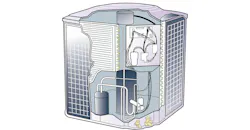
In my previous article, we looked at how positioning heat pumps as silver bullets to energy and comfort problems will backfire on our industry if we don't learn from past mistakes. Over the past 50 years, we've been aiming at the wrong target.
If we correct bad habits and focus on the right targets, heat pumps can deliver their intended outcomes. But to succeed, we must refocus on the skills and craftsmanship each HVAC company provides, then prove results to customers with final measurements of the installation.
This approach is a unique package you can offer to differentiate your company from everyone else offering heat pumps. At National Comfort Institute, we call this package the High-Performance Heat Pump Retrofit. Let's look at what High-Performance HVAC is and how applying this mindset to heat pump retrofits can shift the focus back to your company and its unique skills, rather than simply a component anyone can offer.
The High-Performance Heat Pump Retrofit
If you aren't familiar with High-Performance HVAC, it's a culture and philosophy focused on doing HVAC the way it's supposed to be done. The approach blends industry best practices, air balancing test methods, and building science principles. The goal is to help HVAC professionals who care elevate their companies above low-price, "box‑changing" competitors. It also equips them to profitably solve problems and sell the solutions with confidence and integrity.
High-Performance HVAC is craftsmanship‑driven and relies on accurate measurements, diagnostics, and proven design methods rather than guesswork and outdated rules of thumb. It focuses on system-delivered performance rather than just equipment ratings and yellow tags.
A High-Performance Heat Pump Retrofit embodies the High-Performance HVAC approach and packages it in an actual heat pump installation. Once the project is complete, the customer receives a craftsmanship receipt verifying they got what they paid for. It's the opposite of low performance, which many in our industry have unknowingly delivered for the last five decades. How do we know this? It's simple; we measure it in the field.
Field measurements reveal that low-performance heat pump installations operate at an average of 57% of their laboratory-rated Btu capacity. For example, if you have a 3-ton heat pump rated at a nominal capacity of 36,000 Btu, it probably delivers an average of 20,520 Btu into the home's living space. The "system" would effectively operate at 1.71 tons.
How can results like this happen? There are many ways, and most of them have nothing to do with the heat pump itself. Instead, there are issues beyond the equipment, and many of them already existed. However, they're amplified when you install a new precision heat pump where a gas furnace with a 60° F temperature rise used to sit.
You may think these can't be code-compliant installations that have passed rigorous criteria and checklists. How do they perform once you've jumped through all the code compliance hoops? On average, you improve from 57% to an incredible 63%. Congratulations! You have a code-compliant installation that still does not meet a customer's expectations and consumes more energy than advertised. The customer is still uncomfortable and may have to rely on electric heat strips instead of their old gas furnace to stay warm in the winter.
Isn't it time for this craziness to stop? It can if we look at the right targets. High-Performance Heat Pump Retrofits, on average, deliver 88% of the laboratory-rated capacity into the living space. Now that 3-ton heat pump delivers 31,680 Btu instead of 20,520 Btu and an effective tonnage of 2.64 tons instead of 1.71 tons. In some installation conditions, such as basements, the delivered performance is much higher because duct losses are lower.
The Importance of High-Performance Heat Pump Retrofits
When most homeowners purchase a heat pump, they believe it will automatically provide the benefits and efficiency published on the manufacturer's website or in the brochure. They don't know the difference between low-performance and high-performance installations, and that either could happen in their home. Little do they know, there might be pre-existing issues in their home that could crush their expectations and leave a bitter taste in their mouths for heat pumps. It's important our industry helps homeowners understand a heat pump isn't like a refrigerator, where you unplug the old one and plug in the new one.
What is the easiest way to help homeowners understand the difference?
- Show them proof with measurements;
- Place test instruments in their hands;
- Guide them as detectives in their own homes;
- Ask questions to understand their expectations; and
- Answer their questions along the way.
These steps are critical to give a homeowner control of the type of heat pump system they want. Then show them the hidden obstacles as you test, so they understand what could undermine their expectations.
The four pillars of High-Performance HVAC are comfort, health, safety, and efficiency. Low-performance heat pump installations overlook these foundational principles. Both unsuspecting homeowners and unknowing contractors assume these heat pump benefits automatically happen when the opposite could be the unfortunate reality. Consider these questions:
- How much comfort can a properly sized heat pump provide when there's a 10° F temperature loss between the air handler and the farthest supply register in the primary bedroom?
- How healthy is the air a heat pump installation provides when there's a disconnected return duct pulling 50% of the return air from an attic or crawlspace?
- How safe is a customer with their new heat pump installation after all gas appliances have been removed from the home, but the living space is pulling in air from an attached garage?
- How much savings can the homeowner expect when the variable-speed fan motor consumes four times its rated watts and keeps burning out control modules every two years?
These are tough questions. Unfortunately, it could be a grim reality that both homeowners and contractors must confront if our industry keeps doing what it has always done.
How We Solve the Wrong Target Problem
It's time we take off the blinders and start aiming at the right targets. To ensure we hit the right targets, our industry must look beyond heat pumps to a broader view (the heat pump, air distribution system, and building conditions). Think of these as three rings on the same target. Unless you understand how they all work together in a cause-and-effect relationship, you're doomed to keep aiming at the wrong target.
Remember Matt Emmons? He was in the wrong lane. So are many HVAC contractors, and it's hurting their businesses and the homeowners who purchase their products and services.
High-Performance Heat Pump Retrofits offer a process for identifying and hitting multiple targets at once to deliver results you and your customers both expect. It considers all three rings of the target. It's not a silver bullet, but a silver buckshot approach which combines your skills in design, communication, installation, and commissioning to ensure your heat pump systems hit the bullseye. Is this approach easy? No. It's why many will continue to do what they've always done until the pain of change is less than the pain of callbacks and profit loss.
In the next article, I'll share five tips to help you add High-Performance Heat Pump Retrofits to your product offerings and engage customers with an experience that's both engaging and educational.
About the Author
 David Richardson
David Richardson
Director, technical curriculum
David Richardson is the vice president of training at National Comfort Institute, Inc. (NCI), Avon, Ohio. NCI specializes in training that focuses on improving, measuring, and verifying HVAC and Building Performance.