Demand Response 2.0: Understanding AHRI 1380 in HVAC
Key Highlights
- AHRI 1380 establishes guidelines for variable-speed HVAC systems to actively participate in demand response programs via verified load modulation and two-way communication.
- Contractors need to verify system connectivity, proper commissioning, and firmware updates to ensure compliance with AHRI 1380, emphasizing the importance of integrated controls for simplified compliance.
- Future developments include broader protocol options and increased utility program participation, making AHRI 1380 compliance a valuable skill for HVAC contractors.

As utilities push for smarter energy management and grid stability, the HVAC industry is entering a new era of connected, responsive systems. The AHRI 1380 standard is at the center of this shift, establishing how variable-speed residential equipment can actively participate in demand response programs through verified load modulation and two-way communication. Contracting Business Head of Content Nicole Krawcke recently sat down with Ketan Namjoshi, product manager, residential controls and digital solutions, Bosch Home Comfort Group, to discuss the origins of AHRI 1380, its growing role in utility incentives, and what contractors need to know to stay competitive as demand response moves from optional to expected.

CB: What is the background behind AHRI 1380?
KN: AHRI 1380 was developed as an industry guideline to define how variable‑speed residential HVAC systems should operate within demand response (DR) utility programs. These programs help utility companies manage peak load demands by moving HVAC equipment beyond simple on/off cycling to verified load modulation.
The guideline applies to inverter‑driven and two-stage air conditioners and heat pumps ≤65,000 Btu/h, including residential split systems. Equipment must be able to receive and respond to utility signals using open protocols, primarily OpenADR 2.0b, with defined operating behaviors and homeowner overrides. The goal is to support localized electric grid stabilization while reducing utility bills for homeowners.
AHRI 1380 was published in 2019 and is currently voluntary, but utilities are increasingly using it to qualify equipment for participation in DR programs. For example, CEE Residential Electric HVAC Specifications implemented AHRI 1380 requirements on Jan. 1, 2026, for equipment to be eligible for CEE Tier 1 and Advanced Tier classifications that are often necessary for eligibility with many energy efficiency rebate and incentive programs.
CB: What exactly does AHRI 1380 require that traditional demand response programs do not?
KN: Traditional residential DR programs rely on thermostat setpoint offsets, but these methods often provide limited verification. AHRI 1380 requires measurable, modulated load response from variable capacity equipment. Systems must demonstrate how unit capacity was adjusted during a DR event which is accomplished by two‑way communication and event acknowledgement. This is fundamentally different from legacy “cycling” programs. The intent is to ensure predictable grid response while maintaining occupant comfort.
CB: How are HVAC systems expected to “report back” under AHRI 1380? Are there specific protocols or data formats required?
KN: Under AHRI 1380, residential systems are expected to communicate using OpenADR 2.0 standardized messaging — typically 2.0b. OpenADR handles event signaling, acknowledgements, and reporting between utilities (VTN) and customer systems (VEN). AHRI 1380 does not mandate CTA‑2045 for HVAC systems; CTA‑2045 (EcoPort) is more common in water heaters and appliances. However, some residential HVAC ecosystems may use CTA‑2045 via external gateways as a transport layer feeding OpenADR upstream. Reporting is usually cloud‑based and automated through HVAC OEM platforms.
CB: How does AHRI 1380 affect installation, commissioning, and maintenance workflows for contractors?
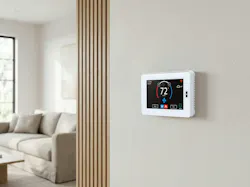
KN: For residential split systems, installers must ensure variable capacity outdoor units, indoor blowers, and communicating thermostats are correctly paired. Commissioning now includes verifying OpenADR connectivity and DR modes, not just airflow and refrigerant charge. Poor connectivity can disqualify systems from DR‑based programs, making system connectivity and cloud registration and verification critical steps. Additionally, maintenance must also include firmware updates and communication health checks.
CB: How do integrated controls help simplify compliance with AHRI 1380?
KN: Integrated manufacturer controls simplify AHRI 1380 compliance by embedding OpenADR‑compatible logic directly into the system. This eliminates the need for external DR boxes that often cannot properly modulate inverter compressors. Integrated platforms automatically manage event response, capacity ramping, and reporting. Compliance then becomes largely software‑driven. For contractors, setup is simpler and more repeatable. For homeowners, this helps to ensure comfort is maintained.
CB: How do you see AHRI 1380 evolving over the next 3–5 years? Will contractors need to retrofit existing systems?
KN: AHRI 1380 is expected to become the default reference standard for residential variable capacity DR programs. OpenADR will remain the primary protocol, potentially evolving toward OpenADR 3.0 over time. New residential split systems will increasingly ship DR‑ready, and utility providers will prioritize systems that can prove performance. Retrofits will focus on controls and connectivity, not full equipment replacement.
In the next year, AHRI expects to release an updated version of AHRI 1380 that will add more protocol alternatives and apply learnings from early adopters of AHRI 1380. These changes are intended to broaden the number of utility programs and systems capable of applying AHRI 1380 demand response. Over the next few years, there will likely be additional modifications with the intent of increasing the options for utilities and manufacturers employing 1380 demand response.
AHRI 1380 compliance knowledge will become a practical skill, and contractors who build their knowledge base now will be better positioned as DR moves from optional to expected.
CB: Are manufacturers providing training or support specifically for contractors around AHRI 1380 compliance?
KN: Manufacturers are actively training contractors on variable‑speed residential systems with DR‑ready controls. AHRI 1380 concepts are often embedded into controls systems, thermostats, and commissioning training. Support focuses on connectivity, DR configuration, and educating homeowners on utility enrollment — although DR program enrollment must be initiated and completed by the homeowner.
CB: Are there opportunities for contractors to differentiate their services by offering AHRI 1380‑compliant systems?
KN: Understanding AHRI 1380, OpenADR, and variable capacity residential systems offers contractors a powerful opportunity to differentiate themselves as utility standards and homeowner preferences move toward widespread DR program participation. By strengthening their knowledge within the category, contractors are poised to offer grid‑ready installs that qualify for cost-saving programs. While the 25C federal tax credit is no longer applicable in this context, incentives are offered at the local utility level and vary by region, creating an important advisory role for contractors, who can educate homeowners on available programs even though they cannot enroll them directly. This not only allows homeowners to benefit from incentives, but it also creates opportunities for contractors to install premium equipment with service plans and connected‑home offerings.
In this way, AHRI 1380 compliance becomes a value proposition, not just a checkbox for compliance.
About the Author
 Nicole Krawcke
Nicole Krawcke
Nicole Krawcke is the Editor-in-Chief of Contracting Business magazine. With over 10 years of B2B media experience across HVAC, plumbing, and mechanical markets, she has expertise in content creation, digital strategies, and project management. Nicole has more than 15 years of writing and editing experience and holds a bachelor’s degree in Journalism from Michigan State University.