The Commissioning Gap: Why Inverter Heat Pumps Underperform — and How Contractors Can Close It
Why It Matters
- Inverter heat pumps require a different installation and commissioning approach than traditional HVAC equipment, and contractors who adapt their processes can reduce callbacks caused by performance gaps between rated efficiency and real-world operation.
- Proper static pressure testing, airflow verification, electrical validation, and control configuration are becoming critical skills as more contractors install variable-capacity systems that are less forgiving of installation errors.
- A documented commissioning process can help HVAC businesses protect margins by preventing avoidable service calls, improving customer satisfaction, and ensuring high-efficiency equipment delivers the performance homeowners expect.
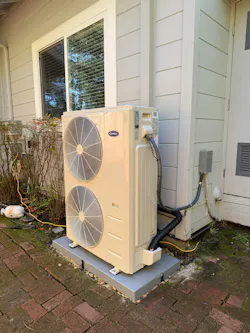
The residential HVAC industry is in the middle of a profound transition. Electrification policies, inverter-driven compressors, and higher efficiency standards are redefining system design and installation practices across the country.
Yet many contractors are facing a recurring challenge: Inverter heat pumps are not consistently delivering their rated seasonal performance in the field. The equipment is engineered to perform. The ratings are verified. But real-world outcomes often fall short. The issue is not technology. It is commissioning.
Modulating Equipment, Fixed-Capacity Habits
Inverter systems behave fundamentally differently from traditional single-stage equipment. Compressor output modulates continuously. Airflow adjusts dynamically. Electrical demand fluctuates with load. Auxiliary heat integrates through logic-based staging.
However, many installation procedures remain rooted in fixed-capacity habits:
- Single-point airflow checks;
- Minimal static pressure diagnostics;
- Quick refrigerant verification; and
- Default thermostat configuration.
This mismatch creates what can be described as a performance gap — the difference between rated laboratory efficiency and delivered field efficiency.
For HVAC businesses, that gap translates into callbacks, margin pressure, and potential customer dissatisfaction.
Where Performance Is Lost
Static Pressure Is Often Overlooked
Inverter air handlers are sensitive to duct system resistance. When total external static pressure is excessive:
- Blower speed increases;
- Compressor output ramps up;
- Electrical consumption rises; and
- Seasonal COP decreases.
In retrofit-heavy markets, elevated static pressure is common. Yet many installations are completed without documented return and supply static readings.
When operating costs rise, homeowners rarely blame duct resistance. They blame the equipment — and the contractor.
Consistent static pressure measurement is not optional on inverter installations. It is foundational risk management.
Auxiliary Heat Engages Too Early
Auxiliary heat staging remains one of the most frequent configuration problems in inverter systems.
Common issues include:
- Strip heat lockout temperatures set too high;
- Thermostats left in aggressive auxiliary mode;
- No balance point calculation; and
- Heat strips activating in moderate conditions.
When auxiliary heat stages prematurely, system efficiency declines significantly.
In many winter complaint scenarios, the issue is programming — not mechanical failure.
For contractors, this distinction matters. Configuration errors generate unnecessary service calls and erode margins.
Electrical Validation Is Inconsistent
Although inverter compressors reduce inrush current, they introduce variable electrical demand during modulation.
Common oversights include:
- No voltage measurement under load;
- No verification of voltage stability during ramp-up;
- Aging service panels in retrofit homes; and
- Limited panel capacity in electrification upgrades.
Breaker sizing alone does not confirm electrical stability.
As electrification accelerates, service panel capacity and voltage performance will become increasingly important operational considerations. Ignoring electrical validation increases the likelihood of nuisance trips and return visits.
The Operational Issue: Commissioning Is Treated as Startup
In many companies, commissioning is compressed into the final stage of installation. For inverter systems, that approach is insufficient.
Commissioning must evolve into a documented, multi-point verification process that includes:
- Static pressure measurement;
- Airflow confirmation;
- Auxiliary heat staging verification;
- Electrical validation under load; and
- Observation of modulation behavior.
This does not complicate operations. It reduces long-term risk.
A Framework HVAC Businesses Can Implement
To close the performance gap, contractors must institutionalize inverter-specific commissioning protocols. Below is a practical structure that can be integrated into business operations.
1. Build Commissioning into Job Costing
If commissioning time is not budgeted, it will be rushed. Companies should:
- Allocate defined commissioning labor hours;
- Use standardized documentation checklists;
- Require recorded measurements; and
- Tie installation quality metrics to verified data.
Commissioning should be positioned internally as a professional service — not a final task.
2. Require Static Pressure Documentation
Every inverter installation should include the following recordings:
- Return static;
- Supply static;
- Total external static; and
- Verified airflow.
Over time, this data becomes a powerful internal quality-control resource. It helps identify recurring duct limitations and design issues. Companies that measure static consistently report fewer comfort-related callbacks.
3. Standardize Auxiliary Heat Configuration
Create a written company policy covering:
- Balance point determination;
- Strip heat lockout settings;
- Dual-fuel staging configuration; and
- Thermostat programming standards.
Consistency prevents technician-to-technician variability and reduces winter complaint rates. Configuration discipline often determines whether high-efficiency equipment performs as expected.
4. Validate Electrical Performance Under Load
During startup, technicians should:
- Measure line voltage at idle;
- Measure voltage during compressor ramp-up; and
- Confirm amp draw aligns with expected modulation behavior.
Electrical validation protects both the contractor and customer from downstream service issues.
As more homes transition toward electrified HVAC, panel capacity assessment will become a critical part of project planning.
5. Educate Homeowners on Modulation Behavior
Inverter systems operate differently:
- Longer runtimes are normal;
- Gradual output adjustments are expected; and
- Reduced cycling improves comfort.
Without explanation, homeowners may interpret proper modulation as a malfunction.
Proactive education reduces unnecessary service calls and builds confidence in the installation.
Commissioning as Competitive Strategy
As inverter technology becomes standard across the industry, differentiation will not come from equipment access. It will come from performance verification.
Contractors who institutionalize structured commissioning processes are more likely to:
- Reduce warranty callbacks;
- Improve online reputation;
- Maintain stronger margins; and
- Justify premium pricing
Commissioning is no longer a technical detail. It is a strategic business discipline.
The Industry Implication
Electrification policies and rebate programs assume high seasonal efficiency in real-world applications.
If commissioning practices fail to support that assumption:
- Utility programs may increase verification requirements;
- Rebate structures may tighten; and
- Consumer skepticism may grow
Contractors are the final performance gatekeepers. Technology innovation alone will not ensure efficiency outcomes. Process innovation will.
The Future Belongs to Measured Performance
The HVAC industry is shifting from equipment-based selling to performance-based accountability.
Inverter heat pumps require commissioning standards that match their technical sophistication.
If contractors continue applying fixed-capacity startup habits to modulating systems, performance complaints will persist.
If the industry embraces structured, documented commissioning practices, the result will be:
- Higher delivered efficiency;
- Stronger business margins;
- Greater consumer confidence; and
- Long-term credibility for electrification initiatives.
The next competitive advantage in HVAC will not be who installs the most inverter systems.
It will be who verifies them best.
Igor Kudinov is a licensed HVAC contractor based in California specializing in high-efficiency residential system design and inverter heat pump commissioning. His work focuses on operational strategies and field verification practices that improve real-world system performance.