Dual Fuel HVAC Systems: Why Heat Pumps and Gas Furnaces Are Gaining Momentum
Why It Matters
- Dual fuel systems give contractors another option for homeowners who are interested in heat pumps but remain hesitant about relying entirely on electric heating, particularly in cold climates.
- Selling dual fuel effectively requires contractors to understand local electricity and natural gas costs, because the economics of switching between heat pump and gas operation can vary significantly by market.
- Emergency replacement calls are an opportunity to educate rather than simply replace like-for-like; contractors can slow down, present multiple options, explain the benefits of dual fuel, and use financing and operating-cost analysis to help homeowners make an informed decision.
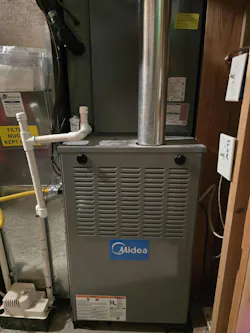
For HVAC contractors, the push toward electrification doesn’t have to mean choosing between heat pumps and gas furnaces. Dual-fuel systems offer a way to give homeowners the benefits of modern cold-climate heat pumps while retaining the flexibility of natural-gas heat when conditions or energy costs make it the better choice. As the technology advances and homeowners become more comfortable with heat pumps, the opportunity for contractors is expanding—but so are the questions around sizing, system selection, controls, selling, and profitability. In this Q&A, David Rames of Midea explains why dual fuel is gaining momentum and what contractors need to know to make these systems work for both their customers and their businesses.

CB: You recently installed a dual-fuel system in your own home? Why did you go with a dual-fuel system?
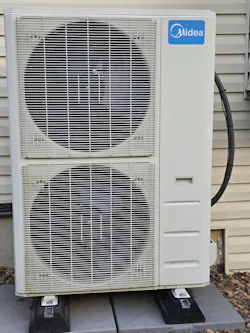
DR: I live in Louisville, Kentucky — the good thing about Louisville is we get all four seasons. So we can have an extremely hot and humid summer, but at times, we can actually have a very cold winter as well. Then we get nice fall and spring weather. So the reason that I chose dual fuel at my house was — and I always say this — it's the Van Halen song, the best of both worlds, right? And it truly is the best of both worlds. In my house, I've got a 4-ton Midea cold-climate heat pump, our coil, and then a third-party gas furnace. That puts the power in my hands as to what I want to use and when. In Kentucky, we're very lucky that the price per kWh (PW) for electricity is low, but the price per therm for natural gas is low as well.
This past winter, we had a pretty bad ice storm. During that ice storm, I manually switched over to the gas furnace because, as the ice is falling, sometimes outdoor unit heat pumps don't like that because the ice starts to form on the unit fan or grill. So, I just switched over to gas with one push of a button, and I kept my house warm. Then, as the ice melted off, I went back to the heat pump. It gives you ultimate flexibility for both electric and gas.
CB: Why do you think dual-fuel systems are gaining momentum right now, especially in markets that have traditionally relied on gas furnaces?
DR: There are a couple of reasons why. The administration in Washington, D.C. has a lot to do with what's popular and what's not, what's incentivized, what's frowned on. The last administration was about getting away from fossil fuels — we're going to decarbonize, we're going to electrify. We're going to have incentives with the Inflation Reduction Act 25C tax credits in order to do that. The new administration is less concerned about natural gas and says it's OK to use it. It's available to us.
Other than the ballot box, we have very little control over any of that, so we have to be able to adapt. Incentives drive behaviors. If you incentivize electrification, then a lot of people will begin to move the heat pump route. If you don't, then they may stay with what they have.
Dual fuel really is that ultimate sweet spot — you've got the electrification for the heat pump, but you've also got that natural gas backup, if needed. And those who are a little hesitant to make that full electrification change, this gives them that safety net of that gas furnace.
CB: Are you seeing increased contractor demand for dual-fuel systems, homeowner demand, or both?
DR: Both. Midea specifically, but also a lot of other brands have shown their high performance in very cold climates. But, because it's still fairly new, there's still hesitancy. We're pumping out heat at temperatures of -15°F.
From the contractor side, if I'm at your house and I go all electric with a cold-climate heat pump and I don't fully believe in the technology and the performance of today's cold-climate heat pumps, I'm a little hesitant. So it makes me feel good as a contractor to know there's that gas backup, too. If you're freezing cold at 2 a.m. on a January morning and you call my office, you've got the dual fuel, the gas furnace to rely on. It provides a safety net for the contractor and the homeowner.
CB: How have homeowner attitudes toward heat pumps changed over the past three to five years?
DR: I think education, specifially from the manufacturers, has helped that. I always say, "It's not your grandpa's heat pump anymore." You've probably heard it from me before. Grandpa's heat pump from 25-30 years ago at 40°F, one of two things happened. Either you relied solely on the auxiliary heater, which is the least efficient way of heating your home, or the heat pump wouldn't keep up. So now you're dropping 3, 4, 5, 6° below set point, and you freeze to death in there. Through the technological advancements of vapor injection, the compressor, and the heat exchanger, heat pumps today are putting out very warm air at very cold outside temperatures. I think through education, consumers are now way more confident in today's heat pumps than they were in Grandpa's day.
CB: What role are utility incentives, energy costs, and regional climate concerns playing in the growth of dual-fuel systems?
DR: Without a national incentive, we have to rely on local utility companies because, I can tell you this, nothing is getting less expensive. Specifically HVAC, because we've gone through some pretty big regulatory changes over the past few years. In 2023, we had an increase in testing and efficiency.
So that doesn't get cheaper. The more efficient things get, it definitely doesn't get cheaper. Then 2025 rolls around, we have a refrigerant change, and we can go from R-410A to an A2L, mildly flammable, either R-32 or R-454B. That doesn't get less expensive. And this is where the 25C goes away. So having local utility providers to help offset some of that increased cost helps homeowners put in higher-efficiency systems instead of DOE minimums. We need to offset, and we need to reward those who make the decision to install higher performance, higher-efficiency systems in their house.
CB: The hybrid vehicle comparison is compelling. Why does that analogy resonate so well with homeowners?
DR: I am one who uses car analogies all the time because that's what we're used to, right? We get up, and we go to work in the morning, we take our kids places, we drive here, we drive there. So we can relate to that vehicle because we know it very well — way more than we know our own HVAC system.
When we think about hybrid, and I'm a big hybrid guy in vehicles and with HVAC, if I don't need a lot of power and a lot of torque and a lot of get-up-and-go, then I can rely on one part of it. And if I really need something else, then I can ride on the other part. I've got the electrical side. I've got the gasoline side. The same thing goes with HVAC. I've got the electric side, and I've got the fossil fuel side. Depending on which one I need, it's there for me. In my situation, I drive a Ford EcoBoost truck. If I'm just driving down the road, I'm going to be very efficient, but I also have a boat. So when I'm towing my boat, I've got twin turbochargers that will kick in when I really need that power and torque, but only when I need it. The same goes with a hybrid car or with a dual-fuel system at your house. We've got both, but only one kicks in when you really need it.
CB: What are the biggest mistakes contractors make when introducing heat pumps to skeptical homeowners?
DR: They think all heat pumps are born equal. I've got a colleague here; we were going to put a field test in his house. He had another brand of heat pump. When we first looked at it, everyone said, 'Well, there's a 5-ton in this house. We need to put a 5-ton back in this house.' I said, 'Hold on, let's look at the performance data.' Once we looked at the performance data, we saw we didn't need all of that.
You need to look at the enhanced performance status and ask, what type of heat is this heat pump putting out versus the other brand? I just did a case study for us down in San Clemente, California. A fellow bought a new house, and we took out 10 tons of cooling and replaced it with 6 tons of cooling. We took out over 100,000 Btu of heating from that house and we put in 3 tons. So the previous system was oversized. We did a Manual J load calculation and sized it the way it's supposed to be sized.
CB: Are there specific words or phrases contractors should avoid—or emphasize—when discussing dual fuel?
DR: You have to be careful. When you change the comfort system in a house, you're doing two things. One is you're making them more comfortable. That should be the ultimate goal. The second goal can save them some money. We have to be careful over promising all of these massive utility bill savings.
There are operational cost calculators online, and I always caution them, don't sell an HVAC system based off of utility savings alone. There's an old saying, 'I can make your system as efficient as possible, I just turn it off.' But you're not going to be very comfortable, are you? But you're going to be super efficient. We just have to be really careful promising huge utility bill savings. Our goal is to make you more comfortable and also maybe save you some money in the process as well.
CB: Are there particular climates, home types, or equipment ages where dual fuel delivers the strongest value proposition?
DR: If you already have natural gas in your home, that's the easiest route, right? In my house, my gas furnace maybe runs 2% of the time. But my heat pump does so well. So if you have natural gas in your house already, and you're in a very cold climate, maybe the best route for you is to go dual fuel. That way we get the efficiency and the stable temperature control of a variable-speed inverter-driven heat pump.
If you're all electric and you don't have gas, the last thing you want to do is add a propane tank outside of your house in order to run a furnace. So if you've got gas already, dual fuel is an incredible option. If you're all electric, then just rely on that cold-climate heat pump and put in an auxiliary heater.
CB: What are the biggest misconceptions contractors still have about heat pumps in northern climates?
DR: The misconception is they still don't think it works. We've got equipment installed in Montreal and the Quebec area. We're in Toronto, in the Ontario area. We're in British Columbia. And you probably saw our case study in Willow, Alaska that we did a couple of years ago, which is an hour or so outside of Anchorage. We replaced their system that was running off of a diesel generator and propane with all-electric Midea heat pumps. They are tickled pink with it. And probably a year ago, we went back and replaced it with the next version of our cold-climate heat pump. If we can do it in Willow, Alaska, we can do it anywhere in the continental U.S.
CB: How important is proper system sizing and controls in maximizing dual-fuel performance?
DR: You should always start with a good Manual J because it will fool you.
What we have to remember is, let's say someone's system is 25 years old. Who's to say that homeowner didn't replace the windows or add more insulation in their attic in the last 25 years? Now, all of a sudden, that envelope is tighter and more efficient. If there's a 36,000 Btu system in that house, why would we ever go back with the same size when they spent the money on efficiency upgrades to the home? Do the Manual J, see what the load calculation is for that house now, and install the right system. If they spent the money on insulation, windows, and doors, we can downsize that unit and actually offset some of this money that they spent on those efficiency improvements.
CB: From a contractor's perspective, are dual-fuel systems generally more profitable than traditional replacements?
DR: I would say yes. And the reason I say that is the overall cost of a dual-fuel system will be higher. You've got a heat pump, a gas furnace, and a coil. So if the contractor puts the same gross margin on a higher-priced system, it will be more profit than the gross margin of a lower-priced system.
One caveat I would throw in there: this is where financing comes in. I think every homeowner, if they had their choice, would want to go with a higher-performing, higher-efficiency system. The problem is the wallet. So, through financing — and everyone should be offering it — we can fit this higher-efficiency, higher-performance system into that homeowner's budget by spreading those payments out over 36 or 60 months, and then let them make the decision on what they want. Offer them options and offer them options with financing.
CB: During emergency replacement season, homeowners often make quick decisions. How can contractors introduce dual-fuel options without slowing down the sales process?
DR: The contractor themselves should probably slow down a little bit. About three years ago, we were developing some of our new products and we interviewed a bunch of consumers all across the U.S. We were trying to figure out what they based their buying decisions on. Probably 70-75% said, 'I just did what my contractor told me to do.'
Anytime I talk to contractors, I tell them that story because you are the expert that they called. Slow down, take your time, give them all of the options. It's going to cost a lot of money. Let's face it, OK, to replace a system, it's going to cost a lot. I would be very upset if I called a contractor and that contractor came in and didn't give me every option and let me make that decision. This is the time; if I'm going to upgrade, now's my chance. Contractors slow down; give them all the options, give them the choice of dual fuel. Educate yourself on the difference and why it's important. Do an analysis on the price per kW and the price per therm for gas in your specific area. Do an operational cost calculator on why dual fuel works. Give them financing; let them make that decision based on education and not spontaneity.
CB: As heat pump technology continues to improve, how do you see the role of dual-fuel systems evolving over the next few years? Do you think dual fuel is primarily a transitional technology, or will it remain a long-term solution for many U.S. homes?
DR: I think they're here to stay. And the reason I say that is, probably a year or so ago, I had our data scientist pull price per kW and price per therm average across the U.S. On average, what's it going to cost me to run natural gas? What's it going to cost me to run electricity? There are still a lot of areas where the price per therm of natural gas is very, very low.
You're in Michigan. Natural gas prices in Michigan are actually very low, very affordable. I think that's a perfect place for dual fuel because if you're going to use that gas furnace and switch from heat pump to gas furnace or back and forth, the price per therm is low. That gives you the option to make the decision that you want to for your own house. There are other areas, like California, New York, and some of the other — we'll call them progressive states — from an electrification standpoint, that price per kW and therm is totally different. And so they want to incentivize electrification. So the price per therm goes up. You need to look at those and analyze which option is best. And in many of those areas, dual fuel is a great option.
CB: If you could give HVAC contractors one piece of advice to help them sell more heat pumps this heating season, what would it be?
DR: A couple of things come to mind. One is to educate yourself on whatever manufacturer it is that you sell. There's plenty of really good ones out there. Educate and know the product. Be the expert. Because again, when that homeowner calls you, they're calling the expert. They don't know anything about their HVAC system, that's not the line of work they're in.
Contractors, you need to rely on your distributor for education. They have classes, they have education, they have training, they have all of that. I will also ask the distributors to rely on their manufacturer for training. When new products are coming out, new efficiencies, new combinations are all coming out, distributor, you need to ask your manufacturer to train you on that. We do a phenomenal job of training our distributors on products and the advantages of each and every one of them. And then that confidence just trickles down. As a manufacturer, we play the biggest part in developing these products. Our distributor now knows these products like the back of their hand. They train the contractor to know the product like the back of their hand. So when that contractor sits at the kitchen table with Mr. and Mrs. Jones, they inject confidence into them that they're making the right decision on the product that they're selling.
I do think a lot of it will rely on what the administration says and where the incentives are. Again, incentives do drive behavior. If you're going to reimburse me for doing something, there's a good chance I'm going to look closely at doing that thing. But again, dual fuel is the best of both worlds. I wouldn't have it in my house if it wasn't a good way to go.
About the Author
 Nicole Krawcke
Nicole Krawcke is the Editor-in-Chief of Contracting Business magazine. With over 10 years of B2B media experience across HVAC, plumbing, and mechanical markets, she has expertise in content creation, digital strategies, and project management. Nicole has more than 15 years of writing and editing experience and holds a bachelor’s degree in Journalism from Michigan State University.