Meet the Young Guns of HVAC: 6 Techs Proving Age Is No Barrier to Success
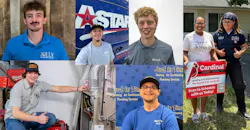
For years, the HVAC industry has focused on the challenge of attracting the next generation of skilled professionals. The good news? They're already here. Across the country, talented young technicians are building rewarding careers, embracing advanced technologies, and earning the trust of customers and coworkers alike. In this special feature, Contracting Business spotlights six outstanding HVAC "Young Guns" whose dedication, work ethic, and commitment to continuous learning are helping shape the future of the industry. Their stories demonstrate that with the right training, mentorship, and determination, the next generation isn't waiting in the wings—they're already making an impact.
Meet Logan Busher

CB: What first sparked your interest in the HVACR industry, and what made you decide it was the right career for you?
LB: I was very undecided on what to do after high school, career-wise and schooling. A long-time family friend's dad started an HVAC family business. I talked to him one day about it, and he convinced me to go to school with his two sons. Right after my first year ended, I started at Jolly. Between school and trying out the job itself in the field here, I decided it was worth sticking to it and make a career out of it.
CB: What has surprised you the most about working in HVAC since you started?
LB: What surprises me the most is probably the number of homeowners that aren't very knowledgeable about an important and expensive part of their home. And that gives me the opportunity to educate and make improvements or repairs to help homeowners however I can.
CB: What's been your proudest accomplishment so far?
LB: I would have to say just being where I am now versus three and a half years ago when I knew nothing. In that time, I've mastered a lot of tasks in the trade, but I'm still always learning. I got my Journeyman license and shortly after became a crew lead for my own jobs. I've helped many customers and really saw a difference in my skillset.
CB: Who has had the biggest influence on your career so far, and what have they taught you?
LB: My biggest influence would be my lead, Jake, who trained me for the whole time I was an apprentice. There isn't really anything I know that wasn't taught to me by him. From installs to service to customer service skills and workmanship.
CB: How has technology changed the way you learn or do your job?
LB: Technology has definitely made aspects of the job easier for me. Especially when it comes to tasks that aren't the labor portion as in customer skills. Having the tech and processes set up makes everything there much more clear, open, and straight forward for me and the customer.
CB: If you could change one misconception people your age have about working in the HVAC industry, what would it be?
LB: I'd say one misconception is that some people think it takes a long time to start seeing the money come in or a lot of time before you're ready to get to the next level or promotion. But I would say those two things come as fast as you want them to if you are willing to put your head down and work and learn to earn them.
CB: Where do you see your career in five to 10 years?
LB: I would like to learn it all or as much as I can moving forward for the next 10 years or so. I'm very confident in my install skills, but I would like to learn service in depth, then after that, the sales and business side, and then, eventually go into business for myself one day when the time is right.
CB: What advice would you give another young person who's considering a career in HVAC but isn't sure whether it's the right path?
LB: I would say just give it a real shot while you're young and have all the time to find out what you really want to do. Get the job and take the initiative to learn and make your job and life easier in return.
CB: What's one thing contractors can do to better attract and keep young technicians?
LB: Be transparent with them. From work experience to finances. A lot of people get into the trades for the money, but it doesn't come in right away as an apprentice. If contractors can show them a realistic growth path with goals and rewards, I think it helps them keep their heads up and the end goal in check.
Lightning Round
Favorite tool: My 11-in-1 screwdriver.
Coolest job ever worked: A few stand-out mansions.
Next HVAC skill to master: Service diagnosis.
Coffee or energy drinks: Neither!
One piece of advice every veteran tech should give new hires: Take the initiative to learn and do anything to get the experience to make your life easier in return.
Meet Dimitri Lamancusa
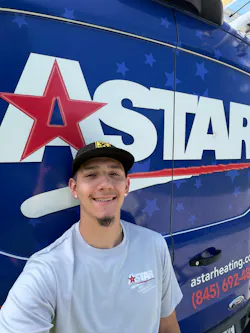
CB: What first sparked your interest in the HVACR industry, and what made you decide it was the right career for you?
DL: I was first introduced to the HVAC industry in 2021 by both a close friend and a family member. In 2024, a life-altering event motivated me to explore a new career path. I chose HVAC because of its versatility and the opportunity to build a stable, rewarding career while continuing to learn and develop new skills.
CB: What has surprised you the most about working in HVAC since you started?
DL: I was surprised by how much learning never stops. You can understand the fundamentals, but every manufacturer, control system, and customer situation is different. As technology advances, our industry will change, meaning there will always be more to learn. That’s one of the things that keeps the job interesting.
CB: What's been your proudest accomplishment so far?
DL: I’m proud of how much my confidence has grown in just a couple of years. Early on, I relied heavily on asking questions, but now I can diagnose many problems independently and explain repairs to customers in a way they understand.
CB: How has technology changed the way you learn or do your job?
DL: Technology has made learning much faster and jobs more efficient. Between manufacturer apps, digital tools, and AI, I can better understand unfamiliar systems and verify information while still relying on my own troubleshooting process. It helps me become a better technician without replacing critical thinking.
CB: If you could change one misconception people your age have about working in the HVAC industry, what would it be?
DL: If I could change one misconception, it would be that college is the only path to a successful career. The HVAC industry is incredibly accessible and offers excellent opportunities for people who enjoy hands-on work. You can get into the field relatively quickly, continue learning on the job, and build a rewarding career with strong earning potential and room for advancement.
CB: Where do you see your career in five to 10 years?
DL: Over the next five to 10 years, I’d like to expand into commercial HVAC and continue developing my technical skills. Eventually, I’d enjoy mentoring newer technicians or becoming a trainer, because I enjoy helping others learn while continuing to grow myself.
CB: What's one thing contractors can do to better attract and keep young technicians?
DL: One of the best ways contractors can attract and retain young technicians is by investing in training and providing quality tools. Showing that you’re willing to help employees develop their skills and set them up for success creates a workplace where people want to build a long-term career.
Lightning Round
Favorite tool: Milwaukee right angle adapter.
Coolest job ever worked: Commercial can/bottle manufacturing plant
Next HVAC skill to master: I don’t think you ever truly master HVAC. There’s always something new to learn or a way of doing things and my goal is to keeping improving every day.
Coffee or energy drinks: Energy drinks, especially Red Bull.
One piece of advice every veteran tech should give new hires: Ask as many questions as you need. It’s far better to ask the same question 10 times than to assume you know the answer and make a mistake. Every experienced technician started where you are, and asking questions is one of the fastest ways to learn.
Meet Luke Neuhalfen
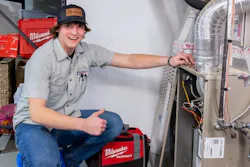
CB: What first sparked your interest in the HVACR industry, and what made you decide it was the right career for you?
LN: I did not want to go to college and wanted to get into a trade. I felt like it was the right choice for me for the variety of work I get to do every day.
CB: What has surprised you the most about working in HVAC since you started?
LN: The complexity of some units and unlimited earning potential.
CB: What's been your proudest accomplishment so far?
LN: Replacing a reversing valve and evaporator coil on one call, in one day, and everything went smoothly.
CB: How has technology changed the way you learn or do your job?
LN: I have access to resources and information instantly that allows me to provide my customer with custom options in an efficient manner.
CB: If you could change one misconception people your age have about working in the HVAC industry, what would it be?
LN: Understanding that system operations are not as complicated as they seem with proper support and training.
CB: Where do you see your career in five to 10 years?
LN: I envision myself being in a leadership role. I am open to management, technical support, or a training leader.
CB: What's one thing contractors can do to better attract and keep young technicians?
LN: Providing a clear path to a long-term career with tangible milestones.
Lightning Round
Favorite tool: Milwuakee M12 Surge Impact.
Coolest job ever worked: I went to a house that had an underground bunker with a 40’ tunnel leading up to it.
Next HVAC skill to master: Geothermal and RTU units.
Coffee or energy drinks: Energy Drinks – Red Bull!
One piece of advice every veteran tech should give new hires: Invest in yourself.
Meet Joey Phillips

CB: What first sparked your interest in the HVACR industry, and what made you decide it was the right career for you?
JP: I was working as an apartment maintenance tech, and I didn’t know how to fix the boiler, so every time the HVAC tech would come to fix them, I would pester him with questions. He finally got annoyed and told me to start looking into HVAC.
CB: What has surprised you the most about working in HVAC since you started?
JP: I think the thing that has surprised me the most is that you can never stop learning. Once I think I have it figured out, there is something new to learn.
CB: What's been your proudest accomplishment so far?
JP: Getting my EPA (certification) — I felt official once I had that. Or having the opportunity to train other people while only being a year into the trade.
CB: How has technology changed the way you learn or do your job?
JP: I still use mainly analog tools and call my teammates for help. But I can see that it is the future with these apps that are connected to the air conditioners and furnaces.
CB: If you could change one misconception people your age have about working in the HVAC industry, what would it be?
JP: That they think this trade will take over their life and give them no free time. I think that’s a common misconception. I’ve had a great work-life balance since starting.
CB: Where do you see your career in five to 10 years?
JP: I definitely see myself as a trainer. I think I have a skill to simplify topic that may be hard to understand while just starting out
CB: What's one thing contractors can do to better attract and keep young technicians?
JP: Give them the help they need. I feel like not knowing what you’re doing at a service call can be one of the scariest feelings. Contractors/businesses should continue to train their techs throughout their career.
Lightning Round
Favorite tool: Flathead or gauges.
Next HVAC Skill to master: Probably getting a better understanding of diagnosing refrigerant issues.
Coffee or energy drinks: Definitely coffee.
One piece of advice every veteran tech should give new hires: To not get wrapped up in learning everything at once. The knowledge will accumulate over time.
Meet Kheira Tuck
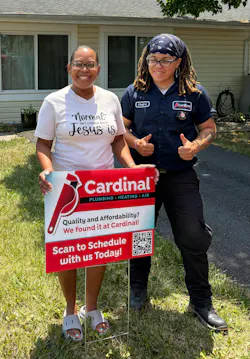
CB: What first sparked your interest in the HVACR industry, and what made you decide it was the right career for you?
KT: I used to work at a very large apartment complex — over 1,000 units. Of course, as maintenance technicians, you have to do everything — plumbing, electrical, HVAC, all the good stuff that involves a home. I really nailed in on HVAC. I'm very technical in my background. I went to college for mechanical engineering. I didn't finish, but I did do about two years of that. And I love doing things with my hands. Combining the technical plus customer service, plus working with my hands, that was kind of the perfect combo.
CB: What has surprised you the most about working in HVAC since you started?
KT: Nothing super surprising. I guess just how nice everyone is. I don't know if it is the area that I switched into, but everyone, at least at my place of work, has been super helpful, just willing to jump in and help me. And also the customers — most of them are not surprised to see a woman technician, which is kind of surprising. A lot of people coincidentally also prefer it. They feel safer with a woman working in their home. So I've had a very positive experience thus far. I had a lot of concerns coming in, but it's been very positive.
CB: What's been your proudest accomplishment so far?
KT: My first solo call; I sold, or at least sent out a lead for $11,000 for a new unit, and I was very nervous for that. That one was a huge accomplishment for me just because I was very nervous, very unsure, but I did everything to make sure that this was the right call for this customer. So it just worked out that way. Also, my job sent me to the Ultimate Technical Academy in Arkansas, and I completed that course with an A, and also got my NATE certification while I was there. I did that in about a week. That was fun, nerve-wracking, and stressful, but also an accomplishment definitely in my book.
CB: How has technology changed the way you learn or do your job?
KT: Not so much in how I learn. I do still like to learn, not the conventional way, but not through AI because I do know that it can be wrong sometimes. Especially out in the field, you're looking at a ton of information on data plates. I'll take a picture of a data plate, say, "Hey, what tonnage is the system?" Or if I can't really find the age on it, what age is the system? Some of the serial numbers and the model numbers, they have a code you have to decrypt and stuff like that. I definitely use that to help me get information I need to make my diagnosis. And sometimes with invoice reports, I use some professional pointers from the internet to make things sound a little bit better, especially when you're conveying to a customer; you want it to be conveyed in the best possible way.
CB: If you could change one misconception people your age have about working in the HVAC industry, what would it be?
KT: A lot of people, when they think of the trades, they think of having that really blue collar task master. It's not like that. I can definitely see that being a thing more so in the union, but definitely not in smaller businesses. Not everywhere wants to kick you down so that they can build you up. Some of them just build you up and want to see you shine so the company also shines. Especially people who are mentoring you because they shine as well. Don't be afraid to make the jump if it is something that genuinely interests you.
CB: Where do you see your career in five to 10 years?
KT: My plan at the moment, at least in my head, is to eventually turn my HVAC skills into becoming a housing inspector. And maybe tackle some real estate on the side through connections that I get through that, and then converging into opening my own LLC for inspections and retiring early and all that good stuff.
CB: What's one thing contractors can do to better attract and keep young technicians?
KT: Be OK with being silly and loosey-goosey. I don't know if that's the best way to put it, but people who present themselves as people, as normal, everyday people. Not everything needs to have this polished look. Your work, yes. But how you present yourself to potential candidates, let them know it's OK to be human. It's OK to show the human side of the business, because I feel like that'll attract the right people that you need. And typically, that is younger people who are also just figuring out how to be adult humans. If you show that you don't have everything together all the time or every workplace has its silly time, I feel like a lot of younger people will be more into hands-on lines of work.
Lightning Round
Favorite tool: My 11-1 from Klein Tools
Coolest job ever worked: We've worked at a couple very large estates. We went to this four-story house, and it was a maze, but it was cool to see how everything ran through the house to get to where it needed to get to go.
Next HVAC skill to master: I guess just getting that closer down. Say a customer needs something, developing my closer, the thing that closes the deal, or makes the customer have faith in me and our company.
Coffee or energy drinks: Coffee. Never energy drinks.
One piece of advice every veteran tech should give new hires: Don't be afraid to ask for help.
Meet Dustin Wilkinson
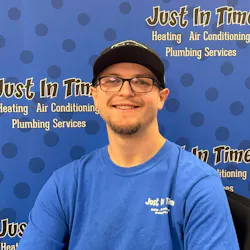
CB: What first sparked your interest in the HVACR industry, and what made you decide it was the right career for you?
DW: I was working in appliance repair and was not very satisfied. HVAC seemed like the next step up for me. After a few weeks riding with a senior technician, I found I loved that we were helping families as well as being consistently busy. Days go by so quickly, it seems.
CB: What has surprised you the most about working in HVAC since you started?
DW: All of the different skills we learn. I also find it really cool to work on really old equipment with all the different parts. I enjoy seeing how much has changed in the industry over the years.
CB: What's been your proudest accomplishment so far?
DW: Honestly, every customer I can make happy and every skill I can master are equal accomplishments to me. I just love to see the progression in my career.
CB: How has technology changed the way you learn or do your job?
DW: When systems are acting very unusual, AI can be very helpful in giving lists of tests to try. AI has proven to be very helpful to me with communicating systems, especially.
CB: If you could change one misconception people your age have about working in the HVAC industry, what would it be?
DW: Generally speaking, my generation expects to join a trade and have 15+ years of learning and growth completed in 1 year; many then quit too soon if they don’t feel like they have progressed. I understand it takes time and effort on our end to grow in this career.
CB: Where do you see your career in five to 10 years?
DW: Honestly, I am not sure. I am still focusing on mastering this craft. I would like to become confident enough that any growth options are realistic and opportunities for me.
Lightning Round
Favorite tool: Kline wire snippers.
Coolest job ever worked: A lake property. I love a good view while working.
Next HVAC skill to master: Brazing.
Coffee or energy drinks: C4 Energy Drink.
One piece of advice every veteran tech should give new hires: Everything in this trade takes time and effort to learn. HVAC is basically looking back every six months to realize how far you have come and how much more you have learned. It takes continual learning and keeping up on all of the changes.
About the Author
 Nicole Krawcke
Nicole Krawcke
Nicole Krawcke is the Editor-in-Chief of Contracting Business magazine. With over 10 years of B2B media experience across HVAC, plumbing, and mechanical markets, she has expertise in content creation, digital strategies, and project management. Nicole has more than 15 years of writing and editing experience and holds a bachelor’s degree in Journalism from Michigan State University.