Tech for Technicians: Tools to Get Your Employees on Top of Their Game
Key Highlights
- The integration of advanced technology in training addresses labor shortages and enhances the quality and speed of upskilling in the HVACR industry.
- Immersive VR environments allow HVAC technicians to practice real-world scenarios safely and accurately before field deployment.
- Mobile training apps provide flexible, simulation-based learning that complements on-the-job experience, boosting technician confidence from day one.

Few business leaders would argue that employee training isn’t challenging, especially in an industry that’s already grappling with labor shortages. For HVACR contractors, upskilling new recruits needs to happen quickly, without compromising the quality of the experience. Unsurprisingly, the tech sector has stepped in to address this, combining immersive experiences that leverage AI and VR, and rapid-fire access to critical data that field technicians need to successfully execute installation, service, and maintenance.
Virtual Reality for Real Results
Interplay Learning, with headquarters in Austin, Texas, delivers immersive training to a number of skilled trades, including HVAC. Its platform combines AI, instructor-led sessions, online simulations, and VR, and offers courses covering subjects such as HVAC supplies; leak, evacuation, and charging; thermostats and heating controls; and NATE ready-to-work exam preparation.
Dan Clapper, Interplay’s head of learner and business outcomes, argues that this approach is more consistent than on-the-job training or the one-off educational events often hosted by manufacturers. At the same time, VR simulations give learners an accurate depiction of what they will encounter when servicing customers.
“We build these 3D environments that are almost like the real world, where people get to practice and learn the proper steps before they go out and do it [in practice],” Clapper explains.
Clapper also notes that the software enables companies to streamline pre-training skills assessments, which results in a more tailored program.
“One of the challenges of training is I have all these employees, and I really don’t know where everyone’s skill set is,” Clapper says. “If we do a really good assessment on the front end, then we can actually individualize learning instead of having everyone take the same thing.”
On the back end, Interplay’s platform updates supervisors on their technicians’ strengths and weaknesses. Clapper notes that this further contributes to creating individualized training experiences and helps managers assign the best techs to specific service calls, based on their current level of expertise.
Mobile All the Way
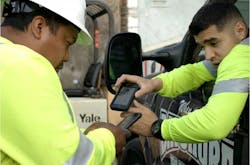
SkillCat, based in New York, offers subscriptions to its mobile training app to individual workers, small to mid-sized employers, and enterprise-level contracting companies. The online training is simulation-based and covers everything from HVAC fundamentals to electrical and mechanical skills, and EPA 608 certification, with exams proctored via the test-taker’s smartphone camera.
“It’s really designed for technicians who want to get into the industry to have all the knowledge they need in order to be confident on day one,” explains Emi Avtalion, head of marketing at SkillCat.
Avtalion advises contractors to combine SkillCat’s online program with on-the-job training for the best results. “A lot of employers have a service manager who is training technicians hands-on, and then they pair our training so that it really sinks in,” she says. With this approach, learners can apply the theories they learn on the platform to real-life situations. “[They] learn why they did what they just did [so that] the next time they see something like that — or even something similar but not exactly the same problem — they’ll understand why it was happening and exactly what they need to do to solve it.”
AI as the Contractor’s Coach
At Housecall Pro, a software developer based in Denver, the focus is on facilitating customer service, dispatching, invoicing, quoting, reporting, and scheduling. Roland Ligtenberg, co-founder and senior vice president of growth and innovation, explained that the platform’s AI-driven tool will also coach home service business owners — including HVACR contractors — on how to grow their companies.
For example, perhaps the business owner’s goal is to make $1 million in sales this year. Based on the specific company data they enter into the system, Housecall Pro’s Coach AI will set sales targets and offer feedback on the contractor’s ability to achieve them based on the size of its current workforce.
“Our Coach AI knows everything about that one business, and it also knows everything about [all of the other] businesses in our database,” Ligtenberg said. “You get this knowledge of the entirety, but also how it applies to your unique business.”
AI-Powered Training and Support
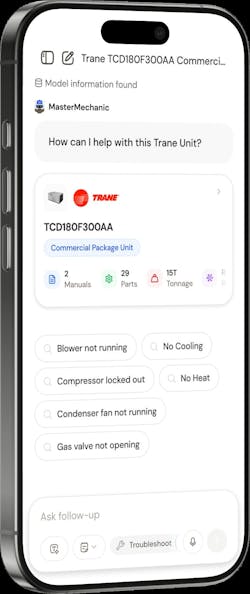
Bluon, with headquarters in Irvine, California, leverages AI and an extensive database to help both HVAC field technicians and office staff deliver better tech support. It is also used for technician training, often on-the-spot during service calls. Techs may either scan HVAC units with their smartphones or conduct searches to access detailed model and part data, including compatible parts, and links to suppliers for information on availability and pricing. They may also connect with an AI tool to perform better diagnosis and troubleshooting.
Peter Capuciati, CEO at Bluon, argues that his company’s training method — wherein technicians look up instructions as needed rather than sitting through training modules that may or may not apply to what they’re currently working on — is well-suited to the way younger techs digest information.
“[Previous generations] learned by memorization, reading, and experiential sorts of connections,” Capuciati said. “Young folks don’t learn that way. They learn by indexing — they learn where to find it.”
This allows new HVACR service techs — who, according to Capuciati, don’t always have the benefit of shadowing more seasoned installers and maintenance workers — to be more confident in their work.
“The old mentor-apprentice relationship is sort of broken,” Capuciati said. “These kids are thrown into a van and told, have at it. They don’t have a mentor, which everybody else did, historically, in this trade.”
While the skilled trades may struggle with bringing new recruits up to speed, Capuciati believes that, thanks to the tools out there, things are starting to improve. He also points to a changing attitude toward the career opportunities that the skilled trades can offer.
“A couple of years ago, there still wasn’t any enthusiasm to enter the trades,” Capuciati said. “They weren’t lining up, and now they are.”
About the Author
 Carolyn Heinze
 Carolyn Heinze
Carolyn Heinze is a freelance journalist based in Paris. She regularly writes about business, construction, electrical distribution, sustainability and ESG, and tech. You may reach her at [email protected].