Why HVAC Contractors Should Use Pressure Independent Control Valves Beyond Skyscrapers
Key Highlights
- PICVs are versatile and underutilized, suitable for a range of building sizes from luxury hotels to residential condos, ensuring precise control with minimal connections.
- Using automatic balancing technology to maintain consistent flow rates despite pressure fluctuations, PICVs replace multiple components with a single device, reducing installation complexity and potential points of failure.
- Proper application of PICVs can significantly cut down commissioning time and rework, especially in complex or high-profile projects.

In a perfect world, nobody notices. When designers and installers zone hydronic systems, the best outcome is for the components to be selected, installed and commissioned in a way that their comfort isn’t affected by quick changes in temperature or clanking mechanical noises. They are oblivious of all those steps, they are simply comfortable. The key to this zoning task is to circulate hot/chilled hydronic fluid into the zone at just the right rate, as if it were cruise control in a car. However, the best technology in the industry to accomplish this task doesn’t need to be reserved for skyscrapers.
Imagine driving to work with an on/off toggle switch instead of a gas pedal. It would not be a smooth or energy efficient way to drive, yet this is how we zone most hydronic systems. Without proper balancing and zone control, hydronic fan coils might short cycle, radiators might click and tick, and the end user might notice any number of comfort interruptions.
Pressure independent control valves (PICVs) are used to regulate the delivery of energy to hot/cold hydronic terminal units. The pressure independent portion of the acronym means that they utilize automatic balancing valve technology. These valves are pre-selected with a specific flow rate range. Differential pressure increases and decreases when zones open and close, the PICV maintains a flow rate instead of drifting higher or lower as you would see with a manual, pressure dependent balancing valve.
The control valve portion of the abbreviation adds the ability to open and close the zone based on a simple on/off 24 VAC signal or a modulating output from a building management system (BMS). PICVs can meter the energy into a space to hit the bullseye with the number of BTUs required to make the space comfortable. They are often found in construction projects where energy efficiency is a key driver. PICVs can deliver energy to a zone at ±5% of the target flow. This accuracy is important, because conditions in zones are dynamic, the amount of sunlight through the window changes, a conference room might be empty one minute and then full of workers with warm laptops the next.
PICVs are frequently overlooked for a wider range of commercial zoning and balancing applications, because it is assumed you need a BMS to operate the valve. PICVs can be used in place of a motorized, paddle-style zone valve with the same simple 24 VAC input.
From a procurement standpoint, a PICV is a single device with two union connections that replaces two similarly sized products: the zone valve and balancing valve, shown in Figure 1. There are hundreds of different combinations for components to select for these two tasks. However, there are two different valve bodies to install, with a minimum of four field connections.
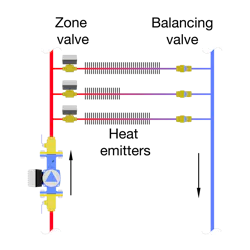
In Figure 2, the balancing and zoning tasks are combined into a single PICV. If it is a simple 24 VAC system, select an on/off actuator. If you want to send a 10 VDC or a (4)-20 mA, you can select a modulating actuator. The installation advantage here is that you only have two field connections per zone for two functions.
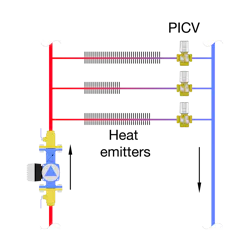
In simplified line drawings, it always looks easy to put the components together. In real life, it can be a huge advantage to cut the number of connections in half.
You see PICVs specified and installed in a building like the Address Downtown in Dubai. It is a five-star hotel and residential high-rise that features 196 rooms and 626 serviced apartments. The expectations for thermal comfort in this high-profile, luxury hospitality sector are unrivaled. A premium balancing and zoning solution is needed to avoid overheating or overcooling a zone. A PICV with a 0-10 VDC proportional signal from a BMS is the most accurate approach.
PICVs are also a great fit in a 10-unit condo building with simple thermostats and on/off actuators. At any scale, balancing and commissioning can be a difficult number of labor hours to budget. Sometimes everything goes smoothly and no rework is required. Sometimes a handful of people are pointing fingers at each other in a spiraling, non-billable troubleshooting process.
If manual fixed- or variable-orifice balancing valves are used, the labor required to match the valve settings to the calculated flow rates per branch is a wildcard. If the as-built drawings match the original plans perfectly, it might not take as long. However, the as-builts rarely match the CAD drawings. Manual balancing is also pressure dependent, so every time a balancing valve is adjusted or a zone opens, it augments flow into all the other branches. Automatic balancing technology, as in a PICV, are pressure independent. The valve adapts to find the target outcome independently of what is happening in the other branches.

The ideal outcome for zoning and balancing is that the installer has everything dialed in before occupancy. This is where PICV technology shines. The least fun part of a commercial project is arguing back and forth between the installers and engineers about why some areas of the building are too hot or cold while the tenants or building owner is breathing down your neck. You reduce your exposure to rework and prolonged commissioning schedules if you select the flow window you set a maximum for the zone and move on to the next project. Nobody wins when the balancing contractor and their manometer are up and down the elevator 100 times (except for the balancing contractor billing the hours).
What are some things to avoid in a PICV application? A limitation of a thermoelectric actuator is that it won’t function properly if it is in an enclosure where it can’t dissipate heat well. As an example, if there is an existing stretch of fintube baseboard with a motorized zone valve within a tight, hand-sized enclosure, it would be best to use another motorized actuator. The baseboard could heat the thermoelectric actuator and keep it open even if it was trying to close. A motorized zone valve would be a better fit in these spots.
Depending on the circulator you are using, you want to keep an eye on the maximum potential differential pressure that a PICV or zone valve could see. This PICV example can close-off in a 58 psid scenario. In outlier applications where that isn’t enough to close the zone, look for a motorized valve with a lower Cv number and higher close-off pressure options.
There is no one-size-fits-all for zoning and balancing hydronic systems. However, PICVs are underutilized in a wider range of projects. Everyone wins when the design flow rate in each branch is easy to achieve and maintain with half the connections. The goal is to keep the mechanical components invisible to the occupants, because they don’t notice discomfort. PICV technology has a wide range of applications to put buildings in cruise control.
For a longer discussion of how and when to apply different balancing valve technologies, read more in idronics™ 34.