The Right HVACR Tools for a Changing Trade
Why It Matters
- A2L-compatible and multi-refrigerant tools can help contractors prepare for changing refrigerant requirements while continuing to service legacy equipment.
- Ergonomic designs, intuitive controls and guided workflows can help newer technicians build skills while supporting technician safety and productivity.
- Understanding tool costs, durability and long-term value can help contractors make smarter purchasing decisions and avoid investing in features that do not deliver meaningful benefits.
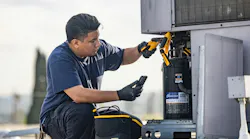
Reliable tools are essential to HVACR contractors’ ability to deliver quality service and keep jobs on schedule. From routine maintenance and troubleshooting to complex installations and refrigerant handling, technicians depend on accurate, durable equipment to work safely and efficiently. As systems become more advanced and refrigerant requirements evolve, investing in dependable tools that can adapt to changing applications is increasingly important.
HVACR tool trends are increasingly focused on helping contractors improve productivity. Manufacturers say contractors want tools that are lighter, easier to use, more accurate, and better connected, allowing technicians to complete service calls more efficiently.
“Make it lighter, make it easier, and make the tools work together,” says Brian Doyle, senior vice president and general manager of CPS Products, of what he hears most from contractors. He notes that manufacturers are increasingly looking to technicians in the field for product development ideas, with weight, connectivity, and long-term refrigerant compatibility shaping innovation. Contractors also want connected tools that reduce the need to switch between devices to diagnose system problems.
Battery-powered equipment and digital technology are gaining traction as contractors look for ways to reduce repetitive work and save time. Scott Mieras, product line manager of tools at DiversiTech, says digital advancements are increasingly focused on delivering measurable value to contractors. “Time = money to the contractor,” he explains.
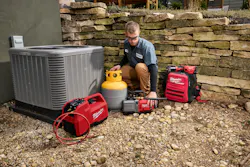
The A2L refrigerant transition remains another major influence on tool purchases, prompting contractors to seek equipment suited to new refrigerant applications without sacrificing versatility across existing systems. Alec Dietzel, group manager of product marketing for plumbing, mechanical, and HVACR at Milwaukee Tool, also points to the innovation around cutting the cord on some of the last traditionally corded products in the HVACR service van: Vacuum pumps and recovery machines. “The driving need is productivity. Technicians can’t afford to spend time searching for outlets or running hundreds of feet of extension cord when they could be moving to the next call.”
Garrett Wong, category director of refrigeration, Malco Group, sees further opportunities in connected tools, automated diagnostics, and artificial intelligence (AI). Digital manifolds, probes, and app-based interfaces can guide technicians through procedures, while connected equipment could automate tasks such as charge adjustments. These guided workflows may help newer technicians achieve proficiency faster and support more consistent service practices amid ongoing skilled-labor shortages.
Cordless Tools Expand Jobsite Flexibility
Battery-powered tools are moving into HVACR applications that traditionally required cords or external power, giving technicians greater flexibility and reducing time spent locating outlets or managing extension cords. Dietzel notes that cordless technology can enable fully cordless service workflows for split systems, including rooftop applications where power access may be limited. However, contractors are evaluating more than runtime and power output when choosing battery-powered equipment. Compatibility across a broader range of tools is increasingly important as HVACR work overlaps with mechanical, plumbing, and electrical applications. “Platform compatibility reduces the need to buy into separate battery systems as the toolbox expands,” Dietzel adds.
The value of cordless technology ultimately comes down to productivity, mobility, and reduced physical strain. Doyle says runtime, charging speed, battery weight, replacement costs, and sustained performance must all factor into purchasing decisions. Manufacturers are working to improve power density, runtime, charging speed, and thermal management while avoiding unnecessary weight and complexity.
Still, cordless technology is not always the best solution for every application. “The question is not, ‘How do we make everything cordless?’ It is, ‘How do we make the technician more mobile and productive?’” Doyle says.
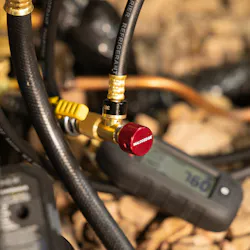
Refrigerant Transitions Drive Demand for Versatile Tools
As A2L refrigerants become more common in residential and commercial HVACR systems, contractors are looking for tools that can accommodate both newer equipment and the legacy systems they will continue to service for years.
Manufacturers are responding with multi-refrigerant-compatible equipment that helps technicians avoid carrying duplicate tools. Doyle explains that flexibility is a key priority, noting that technicians already have plenty of equipment to transport. “We want tools that support the equipment technicians are working on today while also preparing them for where the market is going,” he says. Digital manifolds with multiple refrigerant profiles, A2L-compatible vacuum pumps, and recovery machines are among the solutions helping contractors adapt while maintaining familiar workflows.
As the installed base of A2L equipment grows, refrigerant compatibility is expected to become a routine requirement rather than a specialized feature. Mieras notes that tools are increasingly designed to work across multiple refrigerants, including R-32, R-454B, and R-410A. Manufacturers are also developing solutions to make refrigerant recovery and equipment changeouts more efficient without compromising safety. A2L-compatible leak detectors and recovery equipment will be increasingly important as technicians install and service these systems.
However, future refrigerant changes could require more specialized equipment. Wong says A2L-compatible tools can generally handle A1 refrigerants, but alternatives such as flammable A3 refrigerants, ammonia, and CO₂ present distinct safety and performance requirements. Ammonia and high-pressure CO₂ applications, in particular, may require dedicated tools. Although many contractors will continue servicing legacy systems for years, they need to prepare for a changing mix of refrigerants.
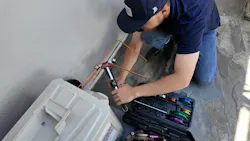
Simplifying the Job for Tomorrow’s HVAC Pros
Tool design is also evolving to meet the needs of the next generation of HVACR professionals, with a greater emphasis on ease of use, intuitive interfaces, and guided workflows.
Younger technicians are gravitating toward digital probes, mobile apps, and tools that provide quick access to measurements and system data. However, Wong emphasizes that digital convenience should complement a strong understanding of HVACR fundamentals. Intuitive controls, clear labeling, and comfortable ergonomics can help new technicians gain practical experience, while online videos, in-app guidance, and accessible training resources can shorten the learning curve as tools incorporate more functions.
As Wong explains, “the new generation of technicians are used to learning through online videos and in-app guidance.” Manufacturers that combine user-friendly design with ongoing education can help newer technicians build confidence and develop the skills needed to diagnose and service increasingly complex systems.
While experienced technicians may be comfortable with traditional methods, newer technicians can benefit from tools that make correct operation more intuitive and reduce the potential for mistakes, Dietzel says. Features such as automatic operating cycles, battery-status indicators, clear visual feedback, and compatibility safeguards can reduce guesswork and help technicians achieve consistent results.
“Technologies such as auto-cycle, battery checks, and Milwaukee’s press blocking system prevent improper ring and ring jaw mismatch and provide peace of mind in quality connections. Ultimately, good tool design should help both experienced professionals and technicians who are still developing their skills,” Dietzel says.
Doyle agrees that tool design must also balance the needs of newer technicians with the experience of seasoned HVACR professionals. “The goal is to create tools that work for both, helping new technicians learn procedures while allowing veterans to work efficiently. Our goal is to make the right process easier and more intuitive,” Doyle says, emphasizing that digital tools should support—not replace—proper training and fundamental HVAC knowledge.
According to Mieras, while younger technicians are increasingly embracing technology to improve efficiency, ease of use remains critical across generations. “The more complex a tool is to use, or more time-consuming it is to set up in order to produce the same results ... typically results in the product being left in the tool bag.”
He adds that meaningful innovation in HVACR tools starts with listening to technicians and identifying ways to reduce time and frustration during installation, maintenance, and repair. Through its Tradeinvent idea submission portal, DiversiTech invites technicians to submit product concepts and compensates them for ideas it acquires.
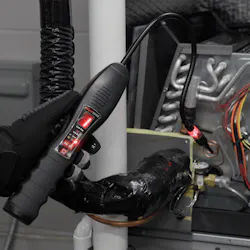
Balancing Tool Costs With Long-Term Value
HVACR contractors must often weigh a tool’s overall value rather than focusing solely on its upfront price. Doyle says purchasing decisions increasingly reflect how much time a tool saves, its durability, whether it can replace multiple tools, and its potential to reduce callbacks. “If a feature does not improve the technician’s day or create real value for the contractor, we have to question whether it belongs in the product.”
Dietzel agrees, noting that a solution that simplifies a process, reduces setup, supports multiple applications, or shares batteries with tools already on the truck can provide value beyond its initial cost. “Historically, contractors have looked for tools that help reduce labor costs and simplify processes, making productivity and platform compatibility important considerations alongside performance and reliability.”
Tools end up being investments, Wong notes. “We’re seeing more young technicians entering the trade and expecting a long-term career, so they’re willing to invest in higher quality tools earlier in their trade pro journey. Trade pros aren’t just looking at individual tool purchases, though. They are also aligning themselves with the tool manufacturer brands that they trust. What they really want is a brand that will truly stand alongside them with service and support so that they have minimal downtime if something happens to go wrong with a tool.”
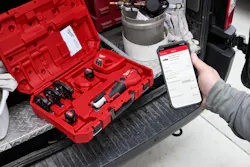
Smarter Tools, Faster Service, What’s Next?
HVACR tool innovation is moving toward connected platforms that help technicians gather information, improve diagnostics, and simplify everyday workflows. As digital tools become more precise, they can reduce measurement errors, minimize refrigerant loss, and provide more reliable data for troubleshooting. Wong notes that these capabilities are becoming increasingly important as system charge requirements become more critical.
Doyle also expects greater connectivity between tools, giving technicians a more complete picture of system performance without requiring extra steps. “One of the questions we ask is: What can we remove from the technician’s day?” Doyle says, pointing to opportunities to reduce equipment weight, setup time, and unnecessary trips back to the truck.
Other innovations are changing how technicians approach common HVACR tasks. Press technology, for example, offers a flameless alternative to traditional brazing for air conditioning and refrigeration connections, potentially simplifying installation procedures and reducing steps such as nitrogen purging. Meanwhile, online product-selection tools and digital resources are making technical information more accessible, helping contractors identify appropriate solutions for specific applications. Together, these developments reflect a broader push toward tools that improve efficiency while making service and installation work more straightforward.
Changes in the contracting and distribution landscape could also influence which tools technicians use. Wong adds that private equity consolidation among contracting companies may increase demand for standardized tool kits across larger fleets, while distributor consolidation could narrow the range of brands available. Although that may limit choices for some contractors, it could also concentrate purchasing around established product lines.
The takeaway for HVAC contractors is to invest in tools that deliver measurable value through improved productivity, safer operation, greater versatility, and long-term reliability while preparing technicians for the next generation of HVACR technology.
Four Tools HVACR Contractors Should Have on Their Radar
The best tool investment depends on a contractor’s service mix, workforce, and business priorities. Industry manufacturers point to four technologies worth watching:
CONNECTED DIAGNOSTICS
1. Connected Digital Manifolds
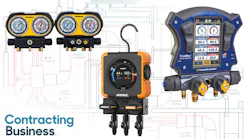
Brian Doyle, senior vice president and general manager of CPS Products, recommends connected digital manifolds for their potential to streamline diagnostics and commissioning. The BlackMax BMD200A connects pressure, temperature, and vacuum measurements, helping technicians get a clearer picture of system performance.
“We do not want to build features and then convince technicians they need them,” Doyle says. “We want technicians helping us define what we build next.”
FASTER INSTALLATION
2. Refrigeration-Rated Press Tools
Press technology offers contractors an alternative to traditional brazing, potentially reducing installation time, fire risks, and callbacks. Scott Mieras of DiversiTech said the labor savings can outweigh the higher cost of press fittings, particularly on larger projects.
“For HVACR contractors, press fittings can offer significant advantages over brazing,” Mieras says.
CORDLESS CONNECTIONS
3. Compact ACR Press Tools
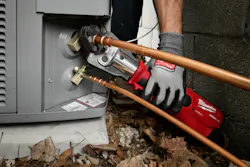
Alec Dietzel of Milwaukee Tool also highlighted press technology, pointing to the M12 FORCE LOGIC Press Tool Kit with ONE-KEY, available with Mueller and ZoomLock MAX options. The tool’s compatible jaws and pivoting ACR rings can help residential technicians make refrigerant connections in tight spaces, including condenser stub-outs, while reducing reliance on brazing torches.
“By providing a flameless alternative to traditional brazing, press can help simplify the connection process and reduce steps associated with traditional methods, such as nitrogen purging,” Dietzel says. As contractors look for ways to improve productivity and simplify workflows, press technology provides an alternative that can change how technicians approach one of the most common HVACR applications.”
REFRIGERANT SAFETY
4. Low-Loss Hoses and Core-Control Fittings
Garrett Wong of Malco Group recommends Safe Seal hoses and Core Control Depressor fittings to help minimize refrigerant release during service connections. These products separate sealing the connection from depressing the service-port valve core, helping reduce the risk of uncontrolled refrigerant blow-off and potential refrigerant burns.
“Having a good set of hoses and connection fittings, like the SS6014 Safe Seal hoses and CCD14 Core Control Depressor fittings, ought to be standard tools for every technician, too,” Wong says.
About the Author
 Nicole Krawcke
Nicole Krawcke is the Editor-in-Chief of Contracting Business magazine. With over 10 years of B2B media experience across HVAC, plumbing, and mechanical markets, she has expertise in content creation, digital strategies, and project management. Nicole has more than 15 years of writing and editing experience and holds a bachelor’s degree in Journalism from Michigan State University.