Daikin Applied Introduces Liquid and Air Cooling Blueprint for AI Factories
Key Facts
- The D60-W reference architecture is based on the NVIDIA DSX AI Factory Platform and NVIDIA Vera Rubin NVL72. Oil-free Magnitude WME chillers provide up to 10 MW of capacity, with dry coolers handling most cooling needs in suitable climates.
- Daikin Applied’s iDCM controls coordinate rack units, CDUs, chillers, and dry coolers, including transitions between cooling modes.
- The modular design includes redundancy, RideThrough, and RapidRestore technologies, and support for air-cooled, liquid-cooled, and hybrid configurations.
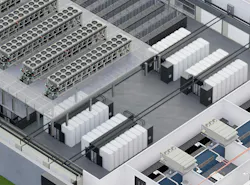
MINNEAPOLIS — Daikin Applied introduced a 60-megawatt (MW) cooling reference architecture designed for artificial intelligence (AI) factories. The D60-W Water-Cooled Chillers with Dry Coolers blueprint is based on the NVIDIA DSX AI Factory Platform and NVIDIA Vera Rubin NVL72.
The architecture connects rack-level cooling, chillers, dry coolers, and controls into an integrated system. It provides data center developers, engineers, and operators with a framework for designing cooling infrastructure from the rack to the outdoor environment.
The D60-W architecture supports a 60 MW IT load across six deployable units. Liquid cooling handles 92% of the load, while air cooling handles the remaining 8%.
The design uses two temperature loops. A high-temperature liquid loop serves coolant distribution units (CDUs). A separate low-temperature loop serves air-cooling rack containment units.
The system centers on Daikin Applied's oil-free Magnitude WME magnetic bearing centrifugal chillers, with capacities up to 10 MW. Dry coolers handle the cooling load for most of the year in suitable climates. Chillers provide additional cooling during the hottest days.
According to Daikin Applied, oil-free chiller technology eliminates oil heaters, pumps, and standard oil servicing requirements. This reduces standby energy use and maintenance requirements. It also eliminates oil-related startup delays when chillers return to operation.
At the rack level, CDUs provide liquid cooling, while DDC Solutions S-Series rack containment units capture remaining heat. The units transfer that heat to the low-temperature cooling loop. Each rack also includes fire suppression and water-loop protection.
The architecture supports air-cooled, liquid-cooled, and hybrid computing configurations operating alongside one another.
"An AI factory is a system of systems," said Karim Shalash, director of Data Center Solutions at Daikin Applied. "A cooling decision at the rack carries implications for water temperatures, flow requirements, plant operation and heat rejection. D60-W gives engineering teams a framework for working through those dependencies and developing a cooling architecture around the facility's operating requirements."
Daikin Applied also incorporated its RideThrough and RapidRestore chiller technologies. These systems address brief power disturbances and support recovery following shutdowns. Redundancy throughout the cooling system helps maintain operation during equipment outages and planned maintenance.
The D60-W architecture uses three cooling modes based on outdoor conditions: dry cooling, hybrid cooling, and full mechanical cooling.
During dry cooling, chiller compressors remain off. In hybrid mode, waterside economizers precool return water before chillers handle the remaining load. Dry coolers provide heat rejection instead of evaporative cooling towers.
According to Daikin Applied, this approach eliminates cooling-tower makeup water and supports low water usage effectiveness (WUE).
The company's iDCM supervisory controls coordinate rack containment units, CDUs, chillers, and dry coolers as one system. The controls manage load sharing, balance equipment operating hours, and coordinate transitions between cooling modes.
The platform also includes integration with site management systems, energy optimization, and predictive maintenance capabilities. Built-in redundancy supports control resilience and centralized system visibility.
The modular architecture allows project teams to add deployable cooling units as data center capacity requirements increase. Daikin Applied also offers commissioning, planned maintenance, and 24/7 emergency response services.
The company's CDU and data center dry cooler remain under development, with availability targeted for the second half of 2027.
Daikin Applied's D60-W reference architecture is available through the company's data center solutions website.