Last month, we took a closer look at the four key components of the vapor-compression refrigeration cycle—compressor, condenser, metering device, and evaporator—and how each one drives the process of moving heat. Together, they raise and drop refrigerant pressure, reject heat outdoors, and absorb heat indoors through phase changes between vapor and liquid. Understanding how these parts connect—and how readings like superheat and subcooling reflect system performance—is essential for grasping how heat pumps deliver efficient heating and cooling.
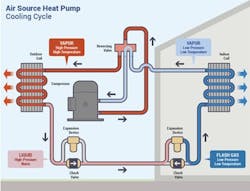
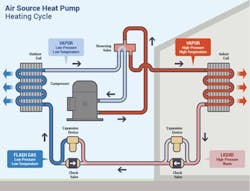
Heat pumps have a unique component that can turn the outdoor coil into an evaporator that absorbs heat and an indoor coil into a condenser that gives off heat. This component is called the reversing valve, and both the suction and discharge lines pass through it.
This valve will always have the discharge line from the compressor feeding into the top, and the suction line to the compressor will always feed into the middle of the bottom three pipes. The reversing valve contains a solenoid that’s energized or de-energized by 24V on the O or B terminal on the thermostat (depending on the manufacturer). A solenoid allows some discharge gas to flow through the valve and create a pressure differential that pushes a slider on one end or another. As you can see below, the slider’s position dictates where the refrigerant comes from and goes, which determines the operating mode.
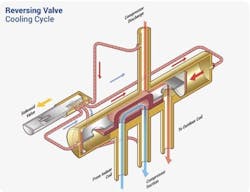
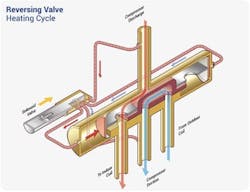
Regardless of the operating mode, one coil still absorbs heat, and the other still rejects heat. It’s just that in heating mode, we’re absorbing that heat outdoors and rejecting it indoors.
Pressure & Efficiency in the Vapor-Compression Refrigeration Cycle
Since the vapor-compression refrigeration cycle moves heat by manipulating pressure, we can gauge its efficiency by looking at pressure ratios. The compressor and metering device divide the refrigerant circuit into a high side (post-compressor: discharge line, condenser, and liquid line) and a low side (post-metering device: expansion line, evaporator, and suction line).
As mentioned earlier, the refrigerant lines that connect the components all have temperatures associated with them. You can also measure the pressure of the refrigerant in them at these points. The suction pressure, as its name implies, is the pressure of the refrigerant in the suction line and is usually measured at the suction service port. On the opposite side of the system, we have the head pressure, which is the high pressure often measured at the service port on the liquid line.
Compression Ratio
The ratio of these is called the compression ratio, which can tell us how efficiently a compressor is pumping refrigerant. To find the compression ratio, we need to take the absolute head pressure and divide it by the absolute suction pressure. To get the absolute pressures, we add atmospheric pressure (14.7 PSI at sea level) to each side. Here is an example of the compression ratio equation:
(340 PSIG + 14.7) / (120 PSIG + 14.7) = ~2.6
Lower compression ratios are associated with better efficiency, but compression ratios that are too low may indicate poor pumping due to a mechanical issue. Here are some typical compression ratio ranges:
● Air conditioning: 2.1–3.5;
● Medium-temp coolers (R-404A): 3.0–5.5; and
● Low-temp freezers (R-404A): 6.0–13.0.
As you can see, some refrigeration systems have higher compression ratios by design. A compression ratio of 4.3:1 might be completely normal for a medium-temp cooler, but in a heat pump, that could indicate the following problems:
● Compressor overheating;
● Oil breakdown;
● High power consumption; and
● Low capacity.
As such, we want to do everything in our power to keep compression ratios low. Allowing for better heat transfer at the coils by keeping them clean is a good way to improve capacity, as is using larger coils and compressor cooling technologies, like enhanced vapor injection (EVI).
Vapor-Compression Refrigeration Is a Journey
It may be helpful to think of the vapor-compression refrigeration cycle as a journey of heat movement. The very principle that says we shouldn’t be able to move heat from a subzero freezer to the outdoors on a summer day has been harnessed to do precisely that. We just have to use a fluid other than air as a vehicle to move the heat and manipulate its pressures to make it absorb and reject heat over and over.
The evolution of vapor-compression refrigeration has also been a historic journey, as the machines we use for comfort cooling, cold storage, and icemaking have been a long time in the making. John Gorrie’s ice machine, which relied on compressed air, paved the way for modern refrigeration technology. Willis Carrier (1876–1950), who is credited with inventing the air conditioner for comfort cooling, used cold coils to remove latent heat from the air, and this invention set humanity on the path to comfort cooling as we know it today. Heat pumps, which would have been inconceivable in Carrier’s time, are becoming a household staple even in cold climates.
All of that is to say that vapor-compression refrigeration technology is here to stay. It’s only getting better; it’s used in more sophisticated systems that can match performance to a wider range of conditions, and we now have better ways to control compression ratios and efficiency. It’s quite exciting to think about, isn’t it?