The Critical Role of Sensors in the Future of HVAC, Refrigeration, and Data Centers
Key Highlights
- High-accuracy pressure, temperature, and gas sensors are essential for optimizing system performance and preventing failures in HVAC, refrigeration, and data centers.
- Total Error Band (TEB) provides a realistic measure of sensor performance under real-world conditions, surpassing point accuracy in importance for system stability.
- Reliable sensors enable tighter control loops, early fault detection, and longer equipment lifespan, reducing maintenance costs and downtime.
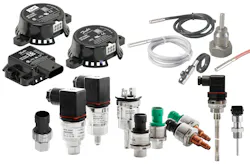
Pressure, temperature, and gas sensors have become essential to the performance, efficiency, and reliability of HVAC, refrigeration, and data center systems. As operators face rising energy costs and increasing sustainability demands, these sensors provide precise, real-time data needed to optimize equipment operation and prevent failures.
High-accuracy pressure sensors stabilize refrigerant cycles and airflow systems, while advanced temperature sensors enable tighter thermal control and reduced energy consumption across cooling intensive environments. Gas sensors further enhance safety and efficiency by detecting leaks, monitoring air quality, and supporting regulatory compliance. Across all three industries, long sensor lifespan and stable calibration directly translate into lower maintenance costs, fewer service disruptions, and extended equipment life. Together, these sensing technologies form the backbone of modern, energy-efficient infrastructure and are critical to achieving long-term operational and environmental goals. OEMs and HVAC pros who incorporate additional sensors in their systems with higher accuracy and reliability are better prepared to meet this challenge.
Industry Trends
The global HVAC market is evolving under the influence of several key forces:
- Energy efficiency and sustainability: Building owners and operators are under pressure to reduce energy consumption and carbon footprint;
- Digitalization and IoT integration: Smart buildings require connected systems that can monitor, analyze, and optimize performance in real time;
- Regulatory changes: Stricter refrigerant regulations and environmental standards are reshaping system design; and
- Predictive maintenance: Data-driven insights replace reactive service models, reducing downtime and costs.
The foundation of system controls that drive efficiency, enable digitalization, and comply with regulatory requirements are sensors. Sensors provide critical information about system conditions, and it is vital to select highly reliable, accurate, and durable sensors when designing or installing systems. Market trends include miniaturization, higher accuracy, and enhanced connectivity. Demand is growing for sensors that integrate seamlessly with cloud-based analytics and building management systems.
Across HVAC, refrigeration, and data center environments, sensors enable smarter, more efficient, and more reliable operation and will play an increasingly central role as these industries push toward higher energy efficiency and lower total cost of ownership. Their ability to deliver precise, real-time data directly influences system performance, safety, and long-term operational stability.
Pressure sensors are foundational to both HVAC and refrigeration systems, where they monitor refrigerant cycles, detect leaks, and ensure compressors operate within optimal ranges. Even slight inaccuracies can lead to improper refrigerant flow, reduced cooling capacity, or premature equipment wear. High-accuracy pressure sensors with long operational lifespans help maintain system balance, reduce compressor cycling, and prevent costly downtime. In data centers — where cooling loads are mission‑critical, pressure sensors support airflow management and chilled water system optimization, directly contributing to lower energy consumption.
Temperature sensors are equally indispensable. In HVAC and refrigeration, they regulate heating and cooling outputs, maintain product integrity in cold storage, and support compliance with increasingly stringent environmental standards. In data centers, temperature sensors form the backbone of thermal management strategies, enabling precise control of server inlet temperatures, and preventing hotspots. The accuracy and durability of these sensors determine how tightly systems can be controlled; higher precision allows operators to safely raise setpoints, reducing energy use without compromising performance.
Gas sensors add another layer of protection and efficiency. In refrigeration, they detect refrigerant leaks early — critical for safety, regulatory compliance, and minimizing environmental impact. Leak detection sensors with extended service life reduce calibration frequency and maintenance labor, improving overall system uptime.
As HVAC, refrigeration, and data center operators face rising energy costs and tightening sustainability goals, the value of accurate, long-lasting sensors becomes even more pronounced.
High-quality pressure, temperature, and gas sensors enable tighter control loops, earlier fault detection, and more efficient system operation. The result is a measurable reduction in energy consumption, fewer service interventions, and extended equipment life. In an industry where reliability and efficiency are paramount, investing in robust sensing technology is no longer optional; it’s a strategic advantage.
Sensor Accuracy: Total Error Band vs. Point Accuracy
A common misconception in HVAC, refrigeration, and data center applications is assuming that a sensor with excellent point accuracy will automatically deliver excellent performance in the field. Point accuracy refers to how close a sensor reading is to the true value under a single, ideal test condition, typically at room temperature, with no vibration, no thermal cycling, and no long-term drift.
For example, a pressure sensor might advertise ±0.1% point accuracy at 25°C.
Total Error Band (TEB), however, tells a much more realistic story. TEB accounts for all major sources of error the sensor will experience during actual operation, including temperature effects, hysteresis, nonlinearity, long-term drift, and calibration stability. That same pressure sensor with ±0.1% point accuracy might have a ±1.0% TEB once you include the full operating temperature range and long-term drift, an order of magnitude difference.
To illustrate this:
- A refrigeration system using a sensor with ±0.1% point accuracy but ±1.0% TEB may see refrigerant pressure readings drift enough to cause inefficient compressor cycling; and
- A sensor with a slightly lower point accuracy of ±0.25% — but a much tighter ±0.5% TEB will deliver far more stable, reliable performance across the system’s full operating range.
This distinction matters because HVAC, refrigeration, and data center cooling systems rarely operate under ideal lab conditions. They face wide temperature swings, vibration, humidity, and continuous runtime. A sensor’s TEB determines how well it maintains accuracy under these real-world stresses, directly influencing energy efficiency, system stability, and maintenance intervals. In systems where uptime and efficiency are paramount, TEB is the metric that truly reflects long-term performance
Future Outlook
Over the next decade, HVAC sensing technology is expected to increasingly leverage AI, machine learning, and advanced analytics to create self-optimizing systems. As connectivity and data-driven decision-making become more prevalent, sensors will play an even greater role in improving energy efficiency, supporting regulatory compliance, enabling predictive maintenance, and enhancing overall system performance. These advancements will help operators achieve greater reliability, lower operating costs, and more sustainable operations across HVAC, refrigeration, and data center applications.
About the Author
 Matt Lauck
Matt Lauck
Matt Lauck is a regional sales director, Americas, for Danfoss Sensing Solutions.