Why It Matters
- More callbacks and unhappy customers: Nuisance GFCI trips can leave otherwise functional air conditioners and heat pumps inoperable, increasing service calls and customer frustration.
- Code compliance is becoming more complicated: With NEC adoption varying by state and local jurisdiction, contractors must understand the requirements where they work to avoid costly installation mistakes.
- High-efficiency equipment is most at risk: Variable-speed and inverter-driven systems are becoming the industry standard, yet they are the equipment most commonly associated with nuisance GFCI trips.
For the last three summers, my home state of Michigan has dealt with severe air quality alerts due to wildfire smoke. As I sit here writing this column, we are under one of those alerts. However, this is the first time I can remember where it smells like a literal bonfire as soon as you step out of the house.
What’s funny is I have no memory of air quality alerts growing up here. It's not that wildfire smoke didn't affect air quality 20–30 years ago—it did. But today's fires are often larger, smoke travels farther, monitoring technology is much better, and public health agencies are more proactive about warning people when fine-particle pollution reaches levels that could pose health risks. For HVAC contractors, these recurring smoke events are also raising awareness of IAQ solutions, from high-efficiency filtration and air purification to proper ventilation strategies, especially for those with allergies, asthma, COPD, and children and elderly adults.
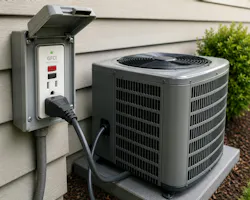
If this summer has reinforced anything, it's that HVAC contractors are increasingly on the front lines of challenges that extend well beyond basic heating and cooling. Whether it's helping homeowners protect their indoor air from wildfire smoke or adapting to evolving codes and regulations, contractors are expected to deliver solutions that keep systems operating safely and reliably. That brings us to another issue demanding the industry's attention: the looming expiration of the National Electrical Code's temporary exception for GFCI protection on outdoor HVAC equipment—a change that could once again put nuisance tripping and service disruptions back in the spotlight.
What’s Happening
The issue dates back to the 2020 National Electrical Code (NEC), which expanded ground-fault circuit interrupter (GFCI) protection requirements to include outdoor air conditioners and heat pumps as a way to improve electrical safety and reduce the risk of shock. While the intent was well-founded, contractors in early-adopting states such as Minnesota and Texas quickly encountered an unintended consequence: widespread nuisance tripping that left otherwise properly functioning HVAC equipment inoperable. Industry experts believe the false trips are largely triggered by high-frequency harmonic signals generated by modern equipment using variable-speed drives and inverter technology—highlighting the challenge of applying decades-old electrical protection devices to today's increasingly sophisticated HVAC systems.
As the Sept. 1, 2026, expiration of the NEC's temporary GFCI exemption approaches, the HVAC industry is warning that the underlying compatibility issues remain unresolved.
“This is critical now because many states are moving forward with a requirement that has not been proven in the field,” says Wes Davis, director of technical services, ACCA. “The extension will expire on Sept. 1; at this time, proof that new GFCI receptacles will perform as expected has only been demonstrated in a UL testing lab. This represents a concerning gap.”
According to Davis, the tripping pattern points toward inverter-driven compressors and variable-speed (ECM) motor systems, which use power electronics that standard GFCI sensing wasn't designed around. But even single-speed equipment has shown signs of experiencing nuisance trips.
“Variable-speed compressors and ECM motors are used extensively in high-efficiency HVAC systems to reduce energy use,” Davis explains. “These motors/compressors are driven by solid-state inverters that switch current at high frequencies to energize the motor phases. A byproduct is high-frequency leakage current that trips a standard GFCI. As the electrification movement encourages more homeowners toward heat pumps, a code requirement that unreliably interacts with that same equipment works against the efficiency and electrification goals the industry and policymakers are both trying to hit.”
He adds that repeated tripping and power cycling are obviously not good for HVAC equipment. While this can be irritating for some customers, it poses a serious health and safety risk during a heat wave or extreme cold snap, particularly for vulnerable populations.
ACCA is joining AHRI in submitting an emergency Tentative Interim Amendment (TIA) request to NFPA seeking to extend the current 210.8(F) exception to Sept. 1, 2028. TIAs go through NFPA's Standards Council for initial screening, then a public comment period, then a committee ballot requiring both a technical-merits majority and a 3/4 supermajority on "emergency nature," before the Standards Council decides whether to issue it.
Adoption of the NEC happens state by state, and sometimes by county or by city. Additionally, states are currently spread across at least five different NEC editions in actie use. To say it’s a patchwork is an understatement.
“Some states have already deleted or amended the outdoor HVAC GFCI requirement outright; others haven't touched it and will become subject to the requirement automatically once the exception lapses, unless the TIA is granted first, Davis says. “That patchwork is exactly why ACCA is pursuing both the national TIA and a coordinated state-by-state push simultaneously — a single national fix isn't guaranteed, so contractors need local answers, too.”
What Contractors Should Do to Prepare
First and foremost, Davis says, is to be aware. “Check whether their state or locality has amended or deleted 210.8(F) for outdoor HVAC equipment. Visit HARDI’s website to learn whether your state has amended their code, operate under an older version of the code, or will begin enforcing this code in September.”
He also advises contractors to:
- Check the stock: If you are impacted, talk to distributors now about whether Class C SPGFCI / HF Class A GFCI devices (UL 943C) are actually available for the equipment they install — not just listed, but in stock.
- Educate the customer: Set customer expectations proactively where a jurisdiction will require GFCI protection after Sept. 1 — including realistic conversations about potential nuisance tripping.
- Write it down: Document any nuisance-tripping incidents in the field. That real-world data is exactly what's needed to support AHRI's Phase II research and any future code revisions.
- Stay connected: Follow updates through your ACCA membership; if you’re not currently a member, now is a good time to join to stay up to date on the latest news about this issue.
As Davis says, ACCA and the HVACR industry in general are not trying to avoid GFCI protection. “We’re asking that requirements be backed by devices that actually work with the equipment they're protecting, before those requirements become mandatory. ACCA supports electrical safety; the ask here is for solutions that hold up in the field, not just on paper.”
In the meantime, ACCA will continue to monitor the situation and will share more as developments unfold.
About the Author
 Nicole Krawcke
Nicole Krawcke
Nicole Krawcke is the Editor-in-Chief of Contracting Business magazine. With over 10 years of B2B media experience across HVAC, plumbing, and mechanical markets, she has expertise in content creation, digital strategies, and project management. Nicole has more than 15 years of writing and editing experience and holds a bachelor’s degree in Journalism from Michigan State University.