How High-Lift Centrifugal Chillers Are Helping Data Centers Scale With Less Water and Energy
Why It Matters
- The rapid expansion of AI and data centers is creating significant demand for advanced cooling infrastructure, opening new opportunities for HVAC contractors with commercial and mission-critical cooling expertise.
- Growing water-use restrictions and sustainability requirements are changing how data centers approach cooling, making dry-cooling systems and high-lift centrifugal chillers increasingly important technologies to understand.
- Advances in two-stage compressor technology and low-GWP refrigerants are expanding chiller operating capabilities, creating new technical training and service opportunities for commercial HVAC contractors.
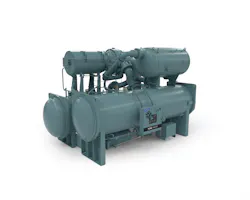
Data centers are scaling rapidly to support increasingly compute-intensive AI workloads, placing unprecedented demands on cooling infrastructure. As operators face growing pressure to reduce water consumption, improve energy efficiency, and lower lifecycle carbon impacts, high-lift centrifugal chillers are emerging as a critical technology for meeting these competing demands. Rather than forcing trade-offs between performance and resource efficiency, the next generation of chillers is enabling both.
As these mission-critical facilities continue to evolve, water availability, energy efficiency, and operational resilience have emerged as strategic infrastructure priorities that influence everything from facility design to long-term operational performance. This shift is prompting a fundamental rethinking of how cooling systems are architected, with growing interest in solutions that can conserve resources, improve efficiency, and support the next generation of high-density computing environments.
These regulatory and resource pressures are accelerating adoption of cooling technologies that reduce dependence on evaporative systems without sacrificing performance. Policymakers and stakeholders are moving toward solutions that prioritize overall resource optimization—balancing operational performance with lifecycle carbon impacts. As a result, water and energy have emerged as strategic infrastructure considerations—not simply operating expenses, particularly for data centers. These factors are increasingly shaping critical decision-making from facility siting to future development and expansion. For example, Nevada has banned the installation and use of evaporative cooling in new commercial and industrial facilities located within the state’s most drought-sensitive regions. Similarly, areas of Arizona, Colorado, and Utah have proposed caps on the daily water consumption of new manufacturing plants and mining operations.
This shift is fundamentally changing how thermal management solutions are designed within these facilities. In the past, evaporative cooling towers were used to maximize efficiency, but they consumed significant amounts of water. A one-gigawatt data center operating continuously with legacy cooling infrastructure could consume as much as 12.2 million gallons of water, or enough to fill about 18 standard Olympic-size swimming pools, per day.
Dry cooling approaches limit water use but often present operating limitations or energy efficiency penalties. For many operators, the challenge is no longer simply adding cooling capacity. It is deploying cooling infrastructure that can support increasingly dense computing environments while minimizing resource consumption and preserving flexibility for future expansion.
Today, advances in two-stage compressor technologies are expanding the role of closed-loop heat rejection and dry cooling strategies by enabling centrifugal chillers to operate efficiently at much higher condenser fluid temperatures while eliminating the need for evaporative cooling towers. As a result, significant water and energy conservation can be achieved in tandem without adding system complexities or sacrificing performance and reliability.
Advancing Dry Cooling Performance With Two-Stage Compressor Technologies
Typical dry-cooling infrastructures address water conservation, but they can be challenged by warmer outdoor environments or operating conditions that carry higher condenser water temperatures. These demanding applications can push the limits of conventional single-stage chillers. As cooling demand increases and condenser temperatures rise, the chiller’s compressor must work harder to manage the lift, in turn consuming more energy.
High-lift centrifugal chillers are specifically engineered for this environment. Built around a two-stage compressor and flash tank economizer, some chillers can operate with condenser leaving fluid temperatures up to 165°F (73.8°C) and a lift up to 110°F (61.1°C). Utilizing two compressor stages, these systems maintain efficient capacity and surge controls across a significantly wider operating range.
Advances in low-global-warming-potential (GWP) refrigerants have also significantly expanded the operating envelope of high-lift chillers. Traditional HFC refrigerants, such as R-134a, limited condenser leaving water temperatures to approximately 122°F (50°C), often requiring evaporative cooling to reject heat efficiently. By using low-GWP refrigerants like R-1234ze or R-515B, condenser leaving temperatures can reach 145°F (63°C), and, when paired with a two-stage high-lift compressor, those temperatures increase to 165°F (74°C). This expanded operating range enables flexible dry cooler solutions even in extreme climates such as Phoenix or Saudi Arabia. Flexibility to optimize systems with warmer condenser water temperatures enables consumers to utilize systems with fewer dry coolers. Alternatively, in noise-sensitive urban environments, wide chiller operating capability can allow dry coolers to operate at lower fan speeds, which can lower sound levels by as much as 20dBA.
The exceptionally wide operating range means efficient and reliable cooling can be achieved in almost any climate while minimizing water dependency. It also enables a significantly more streamlined cooling architecture that eliminates water towers and allows fewer dry coolers to be used. Combined, this supports both water conservation and energy efficiency at the same time.
Unlocking Additional Value Through Heat Recovery
Beyond delivering high-lift cooling, advanced two-stage chillers can enable simultaneous heat recovery, creating additional value from energy that would otherwise be rejected. In high-density computing environments, waste heat is increasingly being viewed as a potential resource rather than an unavoidable byproduct.
Rather than rejecting heat to the atmosphere, thermal energy removed during the cooling process can be captured and repurposed elsewhere in the facility. Under standard operating conditions, these chillers can continuously provide 140°F or greater hot water, creating opportunities to recover and utilize energy that would otherwise be wasted.
This integrated approach can simplify central plant design by reducing the need for cascaded systems, additional electrical infrastructure, or extensive mechanical room modifications. In some applications, it can also reduce dependence on traditional heating sources, including gas-fired boilers.
A single chiller operating under typical conditions can cool IT loads within a data hall while simultaneously supplying reheat to occupied areas across a campus. By recovering thermal energy that would otherwise be rejected, these systems can offset more than 31 MMBtu per hour of heating demand—equivalent to the heating needs of hundreds of single-family homes.
For data centers and commercial campuses, heat recovery transforms a byproduct of cooling into a valuable energy resource. As organizations pursue efficiency, sustainability, and decarbonization goals, integrating heating and cooling within a single platform can help maximize energy utilization while reducing overall site energy consumption.
Evaluating the Complete Carbon Impact of Equipment
It is impossible to rethink cooling infrastructure without also considering the implications of equipment footprint, shipping, and maintainability, all of which contribute to the lifecycle carbon impact. Traditional approaches often rely on adding equipment or multiplying chiller components to deliver results. A standard high-lift system may include a chiller with multiple compressors, or two separate chillers, to achieve higher lift demands. Although the design may be able to handle the load, those added components increase the overall footprint, shipping requirements, and ongoing maintenance.
Replacing standard solutions with high-lift chillers engineered around a single driveline can reduce the overall chiller footprint by as much as 30%, saving valuable space within the chiller plant while also reducing embodied carbon. The single-driveline architecture simplifies the system and reduces mechanical complexity compared to multi-compressor or multi-chiller alternatives. Fewer motors, oil systems, and moving components also help to minimize potential failure points and maintenance requirements.
Additionally, chillers with on-board intelligence can streamline installation and commissioning while helping reduce maintenance requirements through advanced analytics and performance optimization capabilities. With factory-installed connectivity, these “smart-ready” chillers can seamlessly integrate into intelligent central plant optimization platforms without the need for separate sensors or smart control kits.
The Future of Cooling Is Now
In today’s data centers, progress no longer requires resources to be sacrificed. Rather than forcing trade-offs between water conservation, energy efficiency, and operational performance, today's advanced cooling technologies are purpose-built to allow these priorities to work together.
Advances in two-stage, high-lift compressor technologies have expanded what is possible within closed-loop heat rejection and dry-cooling infrastructures. Efficient cooling can now be achieved across a wider operating range without reliance on water-intensive cooling towers. Beyond efficient cooling, these systems enable heat recovery strategies that convert waste heat into usable thermal energy for auxiliary building and process heating applications.
By reimagining thermal management as a design imperative for mission-critical facility advancement, industry leaders can approach resource conservation comprehensively to optimize water conservation, energy efficiency, and operations holistically.