Geothermal HVAC at Scale: How Norton Commons Turned a Design Challenge Into a Community-Wide Solution
Why It Matters
- Geothermal can create new business opportunities in residential and commercial developments where conventional outdoor condensing units present space, noise or property-line challenges.
- Vertical boreholes offer contractors an option for installing geothermal systems on compact lots where conventional horizontal loop fields may not be feasible.
- Norton Commons demonstrates how contractors can move beyond individual equipment installations to participate in larger, community-wide HVAC projects with recurring installation opportunities.

Norton Commons was designed around an idea that feels both traditional and forward-looking: create a walkable, closely connected community where homes, businesses, and gathering places coexist within easy reach. But as the Kentucky development evolved toward increasingly compact lots, that vision created an unexpected HVAC challenge.
Homes were being built on zero-lot-line properties, in some cases with only about six feet separating neighboring houses. Side porches and other outdoor living areas placed residents even closer together. Conventional outdoor condensing units occupied valuable space and, with multiple units operating in close proximity, generated unwanted noise. Their placement also raised potential property line and liability concerns.
For Norton Commons, the issue was not simply how to heat and cool efficiently. It was how to provide comfort without compromising the character of the community itself. Geothermal offered an answer.
“Initially, when they started installing the traditional HVAC condensing units, there were two to four condenser units just grinding and making noise, and they realized they had a huge problem…that’s what spurred the geothermal,” said Ron Thompson, territory manager for the Louisville region at Corken Steel.

Finding a Better Fit for a Different Kind of Neighborhood
The opportunity began more than a decade ago, when an inquiry from Norton Commons about geothermal technology eventually connected the development with ClimateMaster, a manufacturer of geothermal and water-source heat pump systems and Corken Steel, an HVAC wholesale distributor, headquartered in Florence, Kentucky.
As discussions progressed, the team quickly recognized that geothermal could address several challenges at once. Eliminating outdoor condensing units would help solve the immediate noise and space issues while supporting Norton Commons’ interest in sustainable, high-performance construction. The concept was compelling. However, implementing it across unusually small residential lots was another matter.
Some lots were approximately 35 feet wide by 75 feet deep, leaving very little open ground for a conventional geothermal loop field. Corken Steel worked through the technical and logistical requirements to determine how geothermal could be incorporated into the development at scale.
The solution was to treat the geothermal infrastructure almost like another underground utility.

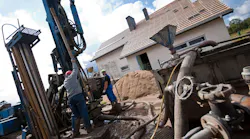
For a typical home, the team developed a design using two approximately 350-foot vertical boreholes. With little available yard space, drilling could take place near and even beneath the garage area. The loops were brought up individually and manifolded in an accessible location rather than placing manifold joints beneath the concrete garage floor.
Drilling was also coordinated with the development process. As new sections of the development opened and utilities were installed, the geothermal contractor could pre-drill an entire street, sometimes 40, 60, or 80 lots at a time, before home construction progressed. This approach transformed geothermal from a system installed individually as an afterthought into part of the neighborhood’s planned infrastructure.
“The drilling contractor drills the entire street, just like a utility company would,” explained Thompson, describing how geothermal drilling was coordinated with other infrastructure work.
A Solution Customized One Building at a Time
Standardizing the approach did not mean every system was identical. Corken Steel continues to review building plans and perform load calculations to determine the appropriate equipment and loop requirements for individual properties. Lots are generally pre-drilled to accommodate systems up to four tons, with additional bore capacity added when a larger home or building requires it.
The development itself has also expanded well beyond single-family residences. Norton Commons now includes live-work buildings with retail or professional space below apartments, as well as standalone commercial properties. That diversity requires a range of ClimateMaster equipment and system configurations.
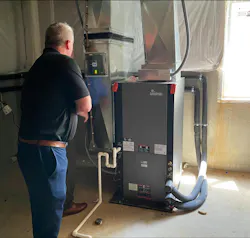
ClimateMaster Tranquility TZ and Tranquility SZ series equipment represents the predominant product used throughout the development, although certain applications have also included additional console units and Trilogy equipment and ClimaDry reheat and dehumidification systems. Some larger homes have required three or four systems, and some of the development’s specialized commercial spaces require larger ClimateMaster equipment.
ClimateMaster Tranquility SZ is a versatile two-stage packaged system series that provides high efficiency ratings, quiet operation, and application flexibility. It offers low global warming potential (GWP) refrigerant, setting an example for eco-friendly performance, and is available in sizes ranging from 2 ton, 7 kW through 5 ton, 17.6 kW. The Tranquility TZ digital two-stage series geothermal heat pump system automatically adjusts to provide optimum and consistent indoor air temperatures and humidity, reliability, and is designed for where space is limited.
One of the development’s particularly challenging mixed-use bakery project required larger, commercially sized equipment (approximately 15 to 20 tons). With little conventional space available for the geothermal field, bore locations were incorporated around the building, including beneath sidewalks and within garage and storage areas.
“We did eventually find enough room for it all,” said Brian Stall, geothermal technical service, Corken Steel, reflecting on the challenge of locating geothermal loops for the mixed-use bakery.
The result is a geothermal strategy flexible enough to support everything from a residence to a demanding commercial application while preserving Norton Commons' compact design.
Building an Ecosystem Around Geothermal
Equipment and engineering were only part of the challenge. When the geothermal initiative began, most HVAC contractors working in Norton Commons had little or no experience with the technology. With numerous contractors involved in the development, successful adoption required a coordinated approach.
ClimateMaster and Corken Steel worked with Norton Commons to create consistency for participating contractors, including a program that provided the same equipment pricing to contractors working within the development. Together, they then helped close the knowledge gap through technical support and hands-on training. Contractors received instruction at Corken Steel’s training facility, at their own locations, and directly on Norton Commons’ job sites. Corken Steel and ClimateMaster personnel assisted with system startup, troubleshooting, and ongoing technical questions.
“We were hands-on the whole time throughout this project, and we continue to provide technical support as it is needed,” added Stall.
During the early stages of the program, the team went even further. For approximately the first year, representatives checked homes before they were released to homeowners, using a checklist to identify installation issues and help contractors through the learning curve. Over time, that investment paid off. Contractors became comfortable with geothermal, technical support calls declined, and a repeatable process emerged involving the developer, builders, HVAC contractors, Corken Steel, ClimateMaster, and the drilling contractor.

From Alternative Technology to Community Standard
Norton Commons’ adoption of geothermal moved quickly. After several months of presentations, feasibility work, and initial installations, the development moved into its North Village phase and committed to geothermal throughout the neighborhood. The requirement was incorporated into the community’s covenants, effectively eliminating conventional exterior condensing units from that portion of the development.
The impact is especially significant because Norton Commons has continued to grow. What began with a small number of geothermal installations has developed into approximately 130 to 150 installations per year, with years of additional development still anticipated.
For homeowners, two benefits stand out repeatedly: quiet operation and low utility costs. Residents have reported remarkably low utility bills, including anecdotal reports of utility costs below $100 for some approximately 2,500-square-foot homes. While no formal comparative energy study has been conducted for the development, the homeowner feedback has been consistently positive.
Just as important in a neighborhood designed around porches, sidewalks, and close interaction between neighbors, geothermal eliminates the sound of outdoor condensing equipment competing with those spaces. By moving the heat-exchange function underground, Norton Commons could preserve the density and outdoor environment that were central to its original vision while simultaneously creating higher-performing homes.
A Model Other Developers Are Watching
More than a decade after the initiative began, Norton Commons has become more than a successful geothermal development. It is an example for others considering how geothermal can be incorporated into a community from the beginning. Other developers have visited Norton Commons to see the approach firsthand, and Corken Steel and ClimateMaster have been involved in discussions and projects inspired in part by what has been accomplished there. That influence may ultimately be one of the project’s most important outcomes.
Norton Commons demonstrates that geothermal does not have to be approached simply as an HVAC equipment choice made one building at a time. With planning, engineering, contractor education, and strong collaboration among manufacturers, distributors, developers, and trades, it can become part of the infrastructure of an entire community.
For Norton Commons, the decision solved an immediate problem with noise and space. But the partnership with ClimateMaster and Corken Steel ultimately delivered much more: a scalable approach to quieter, more efficient and more sustainable development—and a model that can be repeated elsewhere.