Why It Matters
- Combustion safety is critical to protecting customers. Technicians who understand carbon monoxide (CO) diagnostics can better identify potentially dangerous furnace operating conditions before they become serious safety concerns.
- Initial readings don't tell the whole story. Monitoring CO and oxygen levels throughout the furnace run cycle can reveal combustion problems that might otherwise go undetected during a quick startup check.
- Identical equipment doesn't guarantee identical performance. The two furnaces in this example operated differently despite being the same model and installed in the same home, reinforcing the importance of testing each system individually.
One morning, early this spring, I logged onto my company laptop, quickly read through my emails from the night before and then pulled up my upcoming class schedule.
My heart dropped when I noticed I was scheduled to teach the Combustion Performance and Carbon Monoxide Diagnostics class in New Berlin, Wisconsin in the fall training season.
This might not sound like a big deal to you, but in my opinion, this is the most important class National Comfort Institute (NCI) teaches. I watched the class roster for months, hoping the class would be cancelled so I could get off easy. Turns out, it was a go.
Don’t get me wrong, I’ve been preparing for this moment for years. I sat through the class countless times and had been doing ride-alongs with a local company, trying to get as many reps in as possible before the class. When I first found out about the class, I didn’t believe in myself and was convinced that I would fail. The one thing that kept me going was a conversation I had with Jim Davis after learning about my upcoming training.
Jim assured me that I could do it. He said, “If I didn’t think you could do it, I wouldn’t let you teach the class.” Even after Jim passed earlier this summer, his words continued to echo through my head. I was determined not to let him down. Jim had endless stories about everything he learned during his job site visits with contractors. What would be a better way for me to prepare than to get back out into the field and work on live equipment?
Practice How You Play
There are times in my life when I considered myself to be extremely lucky, and, then again, there are other times when I have thought of myself as having the worst luck in the world.
I realized that, “Luck is what happens when preparation meets opportunity.” — Seneca
I took every opportunity I could get to study the class manual. There were also several times when I went out with technicians so I could try to practice explaining some nuances of combustion diagnostics.
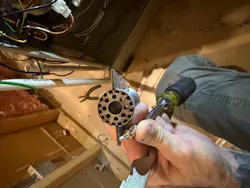
Unfortunately, most of the calls we made were on newer equipment. While we got some practice installing test ports, it wasn’t until the end of the second day that we came across something juicy.
Identical Furnaces with Different Results
We arrived at a house that had two 95% efficient natural gas furnaces. One heated the basement and first floor. The other furnace heated the second floor.
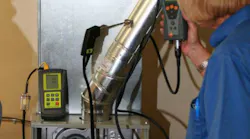
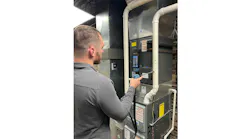
We started off looking at the second-floor furnace. The tech I was with installed a test port in the PVC flue pipe, and he inserted the analyzer probe with the pump running. Then, we cycled the heat on. We monitored the analyzer during the first 60 seconds to ensure we had a clean burn during light-off. Then we allowed the heat to continue running and captured three measurements over a period of 15 minutes. The purpose of this is to look for a trend during the run cycle. It is important to make sure both the CO and the O2 remain stable and within acceptable ranges.
Nothing jumped out at us, so we pulled the flame sensor wire to cycle off the burners while we monitored the analyzer during shutdown. Check the box on the invoice for another boring one.
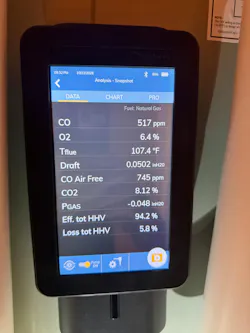
Next, we looked at the first-floor furnace. Once again, we started with light-off. The CO spiked at around 600 parts per million (ppm) and then quickly dropped below 100 ppm. While staring at the analyzer at the beginning of the run cycle, I was anticipating another boring furnace. But this one ended up being a lot more interesting.
While watching the analyzer during the run cycle, we noticed that the CO reading started to spike while the O2 measurement began to fall.
Could this furnace actually be over-fired even though the initial O2 reading was almost identical to that of the second-floor furnace? Another thing that was odd was that the stack temperature wasn’t crazy high, and neither was the temperature rise.
There was only one way to figure this out. We unscrewed the cap on the gas valve and slowly reduced the gas pressure. After backing out the adjustment screw a little over half a turn, the CO dropped below 100 ppm, and the O2 once again increased. The oxygen stabilized just over 10%.
The interesting part is that the oxygen was above the “normal” range, yet the furnace was now operating properly. Two identical furnaces in the same house but operating differently. One maintained stable combustion readings at that gas pressure, while the other one did not.
Teaching the Class
A few weeks went by, and I headed to Wisconsin to teach my first combustion class. On the morning of the class, I felt a sense of peace as the techs began to fill the room. I thought back to the morning that I traveled to Michigan to learn combustion from Jim Davis himself. I remembered looking at the size of the manual and feeling completely overwhelmed.
I had come a long way since that morning when I sat in the first row, dodging the combustion analyzer that Jim tossed at me.
I realized that Jim and I were like those two furnaces: similar on the outside, but different in how we operated. We both represented NCI in our blue shirts, standing in front of the room, and teaching from the same book. I think the thing I was most worried about was trying to be like Jim and attempting to fill his shoes.
Jim left his mark on me, and was a great mentor. Now, I can bring my own approach to teaching the class while keeping his legacy alive. Just like those furnaces, we are the same but different.
About the Author
 Adam Mufich
content developer and instructor
Adam Mufich serves the HVAC industry as content developer and instructor for National Comfort Institute, Inc. (NCI). NCI specializes in training that focuses on improving, measuring, and verifying HVAC and Building Performance. Find them at www.nationalcomfortinstitute.com.