Why the Old Troubleshooting Playbook No Longer Applies
Why It Matters
- Modern refrigeration systems depend heavily on sensors, logic, and safety routines, which influence system behavior before mechanical issues become apparent.
- Understanding the system’s decision-making process, especially with A2L refrigerants and transcritical CO₂ systems, is crucial for accurate diagnosis and effective repairs.
- Technicians should mentally split the system into mechanical and control sides to better identify the root cause of issues and avoid misdiagnosis.
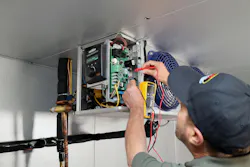
Walk into almost any job today and, at first glance, everything looks familiar. Compressors, evaporators, condensers, piping — the same basic layout many of us have been working on for decades, with nothing that immediately signals this system is going to challenge how you think.
But if you have been in the field recently, you already know something is different. These systems do not behave like the ones many of us learned on. In some cases, they behave nothing like them at all.
After 41 years in this trade, I have had to adjust how I troubleshoot more in the last decade than I did in the first three. The fundamentals are still there. Physics has not changed, and refrigerant still moves heat the same way it always has. What has changed is what drives the system, how decisions get made, and how the system protects itself. The biggest shift is not mechanical — it is the controls.
When the System Starts Making Decisions
Modern refrigeration systems depend heavily on sensors, logic, and safety routines just to operate. Long before a technician arrives, the system has already been making decisions based on what its sensors tell it is happening — and that changes how problems appear in the field.
A symptom that looks exactly like something you have diagnosed a hundred times before can still send you chasing the wrong issue. High head pressure, unstable suction, warm cases: on the surface, it all feels familiar, but the cause behind it may be rooted in the control side, not the mechanical one.
Technicians who troubleshoot today the same way they did 10 years ago will likely work harder than necessary — not because the fundamentals are wrong, but because the system is no longer reacting the way they expect it to.
Symptoms Do Not Mean What They Used To
Consider the most common symptoms: high head pressure, warm cases, nuisance alarms and systems that refuse to stay online. Years ago, those symptoms traced back in a fairly straight line. High head pressure usually meant airflow or charge issues. Warm cases meant feed or capacity problems. A system that was down usually meant something had failed — and most of the time, it was a direct path from symptom to cause.
Today, those same symptoms can come from a mechanical issue, a drifting sensor, a controller decision or a safety routine doing exactly what it was designed to do. Standing in front of the rack, every one of those situations looks identical. The system is reacting — but what it is reacting to may have nothing to do with what is actually happening in the refrigerant circuit.
Experienced technicians can chase a problem for hours because of this. The symptoms are real, and the response is logical. The underlying cause is simply not where instinct says it should be.
Splitting the System in Your Mind
One adjustment that pays off in the field is learning to mentally divide the system before you pick up a gauge. On one side sits the mechanical: refrigerant flow, compression, heat transfer, and oil return, governed by the same rules they always have been. On the other side sits the control side: sensors, transducers, controllers, logic and safety routines, which collectively tell the system what it believes is happening.
Those two sides do not always agree. The mechanical side reflects what is physically happening. The control side reflects what the system thinks is happening. When both are accurate, troubleshooting feels straightforward. When they diverge, you can question everything you see until you slow down and confirm which side is giving you bad information.
When Mechanical Gets the Blame
Mechanical components take the blame more often than they deserve on modern systems. High head pressure, fans ramping, valves hunting, pressures that never settle — the instinct is to go mechanically. Check the condenser, verify airflow, inspect the charge, look at the coil. All valid steps worth taking.
But some calls turn up nothing wrong mechanically. Clean coils, good airflow, charge exactly where it should be, yet the system still behaves as though it is in trouble. That is the moment to ask the most important question on the call: do you trust the data being presented?
A pressure transducer or temperature sensor that has drifted — even slightly — feeds the controller a picture of conditions that do not exist. The controller responds to that picture: ramping fans, repositioning valves, limiting capacity are all based on a reality the system has constructed for itself. From the outside, it looks like a refrigeration problem. On the mechanical side, nothing is wrong. Verifying a sensor against a trusted gauge or thermometer is a 5-minute step that can redirect an entire call.
A2L Systems: When “Down” Means “Protected”
A2L refrigerants introduced a layer of system logic that caught a lot of technicians off guard when these units first appeared in the field. Cases warming, compressors not running as expected, the rack appearing as a serious problem — the presentation is identical to a mechanical failure. The difference is what triggered it.
In many of those cases, the refrigerant detection system has done exactly what it was designed to do: it sensed a condition, triggered a safety routine, and shut down to protect the occupied space. The system is not broken. It is protecting the building. The real work is not diagnosing a failure — it is understanding the decision the system made and whether the condition that triggered it was genuine.
That distinction — between a system that has failed and a system that has responded — is the same fundamental question that applies across every technology covered here. A2L makes it harder to miss because the consequences of getting it wrong are more visible.
CO₂ and HFC Systems: Less Margin For Guessing
CO₂ systems operate in a much tighter window than conventional refrigerants. Small deviations in ambient conditions, sensor accuracy, or control logic can produce significant swings in system behavior, and transcritical systems do not forgive assumptions. What the system believes is happening and what is actually happening can diverge quickly, which makes verifying sensor inputs a first step rather than a last resort.
Modern HFC racks present a different version of the same challenge. Floating head pressure, adaptive controls, and energy-optimization routines can make a system look like it is performing poorly when it is operating exactly as designed — unloading compressors or backing off capacity to hit a target that simply is not visible on a standard gauge set. Before drawing any conclusions, the question to ask is whether the behavior represents a system response or a true fault.
The Most Expensive Habit in the Field
One pattern wastes more time on modern service calls than almost anything else: jumping too quickly to the first assumption. Pressures look off, so the charge gets questioned. Superheat looks unstable, so the valve becomes the suspect. The system is down, so something must have failed. Parts get replaced, time runs out, and the real issue stays hidden.
What often gets skipped is the control side entirely. Alarm history never gets reviewed. Sensor values are trusted without verification. Few technicians stop to ask not just what the controller is doing, but what they believe is true.
Skipping those steps is not a skills problem. These systems simply require a troubleshooting mindset that accounts for the gap between what the system perceives and what is happening in the equipment.
The Shift That Matters Most
The shift is not about abandoning what works — it is about adding one more layer of discipline to how a call gets approached. Verify inputs before reacting to outputs. Pull alarm history before pulling a panel. Understand what the controller is trying to accomplish before deciding it has failed. Those habits do not replace mechanical knowledge — they make it more effective.
When a technician approaches a call that way, the frustration drops. Time on site drops and the system starts making sense because the technician is reading both sides of it — what the equipment is doing and what the controls believe the equipment should be doing.
The systems have changed. The way we think about them must change with them.
About the Author
 Chris Thomas
Chris Thomas
Chris Thomas is the supervisor of Product Services at Heatcraft Refrigeration Products.